An Arkus Innovation Studios publicationPeople & possibilities
The Arkus Signal
Grants and funding opportunities worth pursuing
FUNDING EDITION7 OCTOBER 2026ISSUE 04 / DIGITAL EDITION
Grants & research funding
The application begins before the writing.
WSMA offers fifteen $10,000 awards, but every application needs two to five real partners, BizLink readiness and a plan to reach at least 35 Washington businesses.
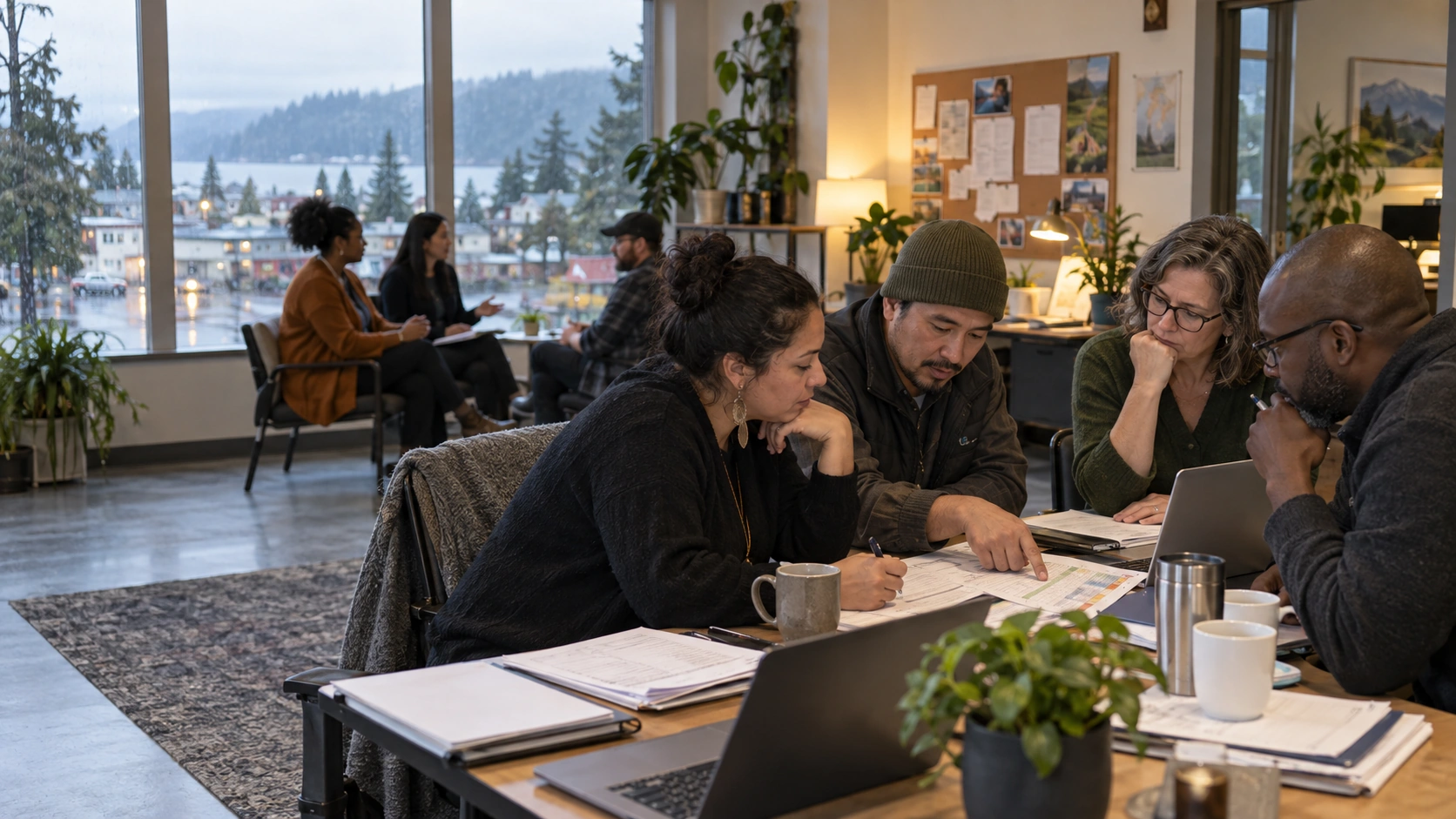
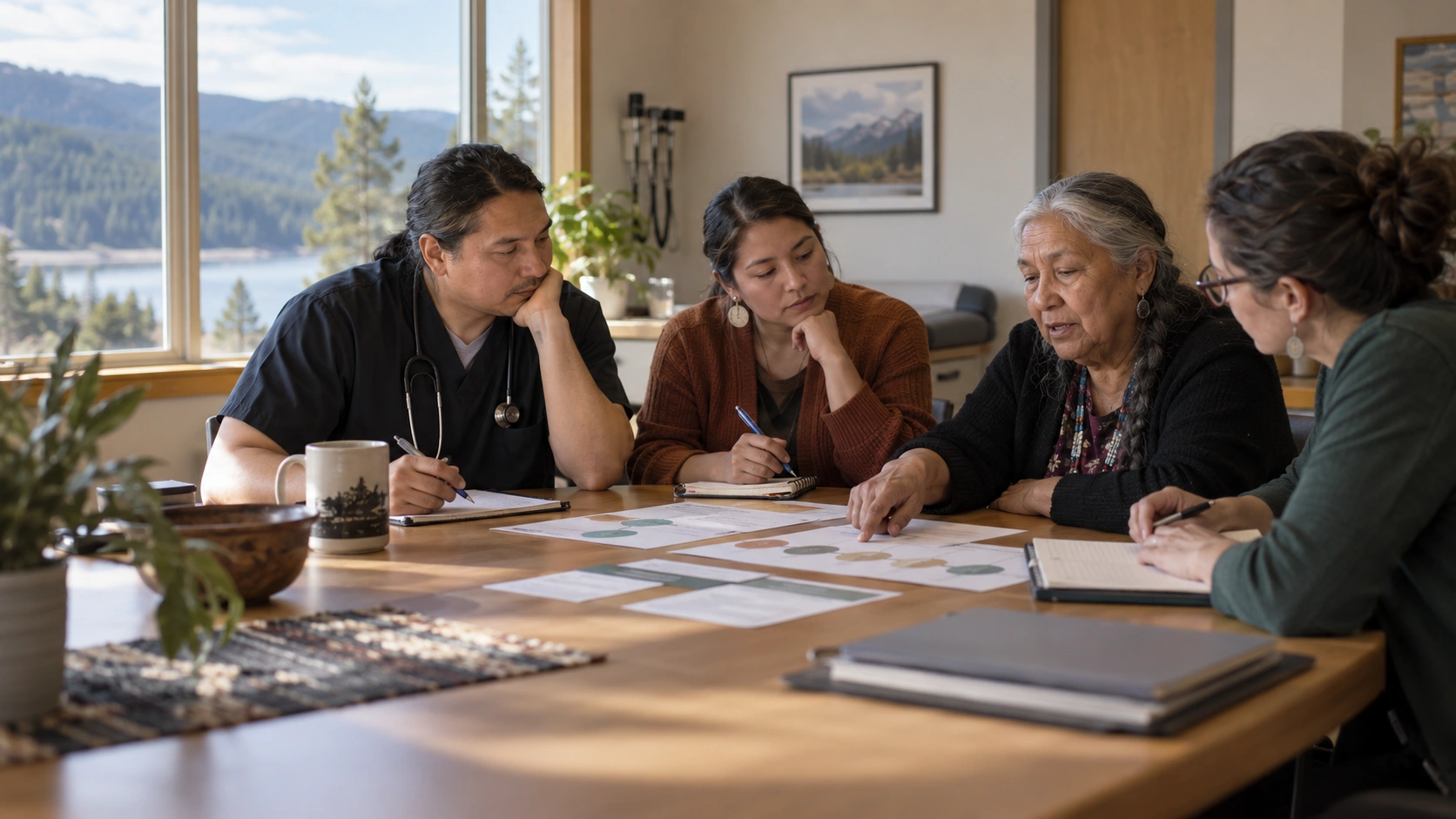
Business-support partners review a collaborative project checklist around a community-office table. AI-generated illustration; not a photograph of this project.
The WSMA award is modest by grant standards and demanding by design. Every applicant needs a Washington lead, two to five qualified partners, current BizLink records, and a plan to reach at least 35 businesses.
Inside: ten funding stories. Three calls are new or reopened, while the rest earned their place through deadline pressure, corrected eligibility or clear strategic fit.
Reachable means ready
Two kinds of runway.
Choose a call to see what must exist before filing.
Washington State Microenterprise Association
Build the collaborative first.
Recruit the collaborative, verify every BizLink profile and assemble the 2026 W-9 and Excel-only Fund Request Form.
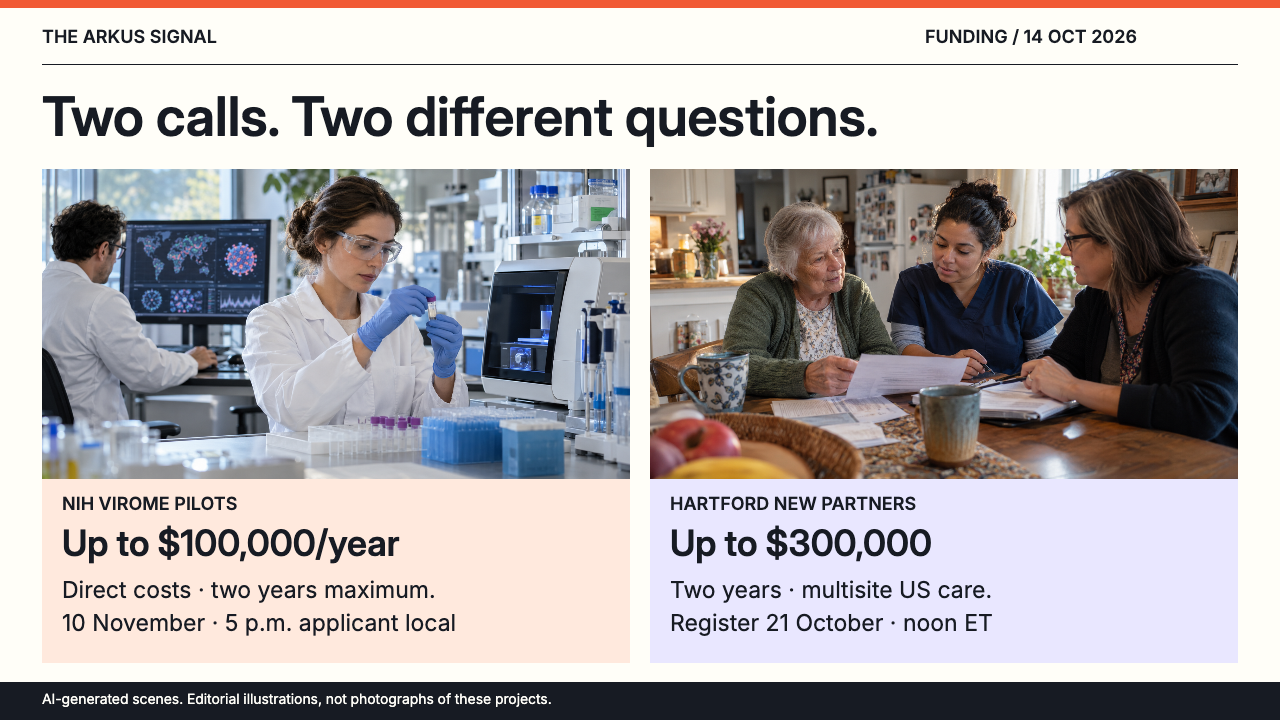
Read both parts of the announcement for the Isotope R&D and Production calendar. Then start DOE's PAMS registration and complete SAM.gov and Grants.gov setup.
$5,000 floor, $10 million ceiling, $400 million total program funding30 September 2027 · 11:59 p.m. ETRules & application steps ↗
AI-generated editorial scenes. WSMA requires a real partner structure and current records. DOE remains open longer, but topic panel dates may control earlier action.Explore the opportunities ↓
THE ARKUS SIGNAL / FUNDINGTHE OPPORTUNITIES / 02
OPEN / United States; foreign work requires careful structuring
Isotope science gets a year-long runway
1 min read ·
DOE’s $400 million Office of Science program names isotope research, but applicants must find the right panel date before treating September 2027 as the deadline.
U.S. Department of Energy, Office of Science · FY2027 Continuation of Solicitation for the Office of Science Financial Assistance Program, DE-FOA-0003665
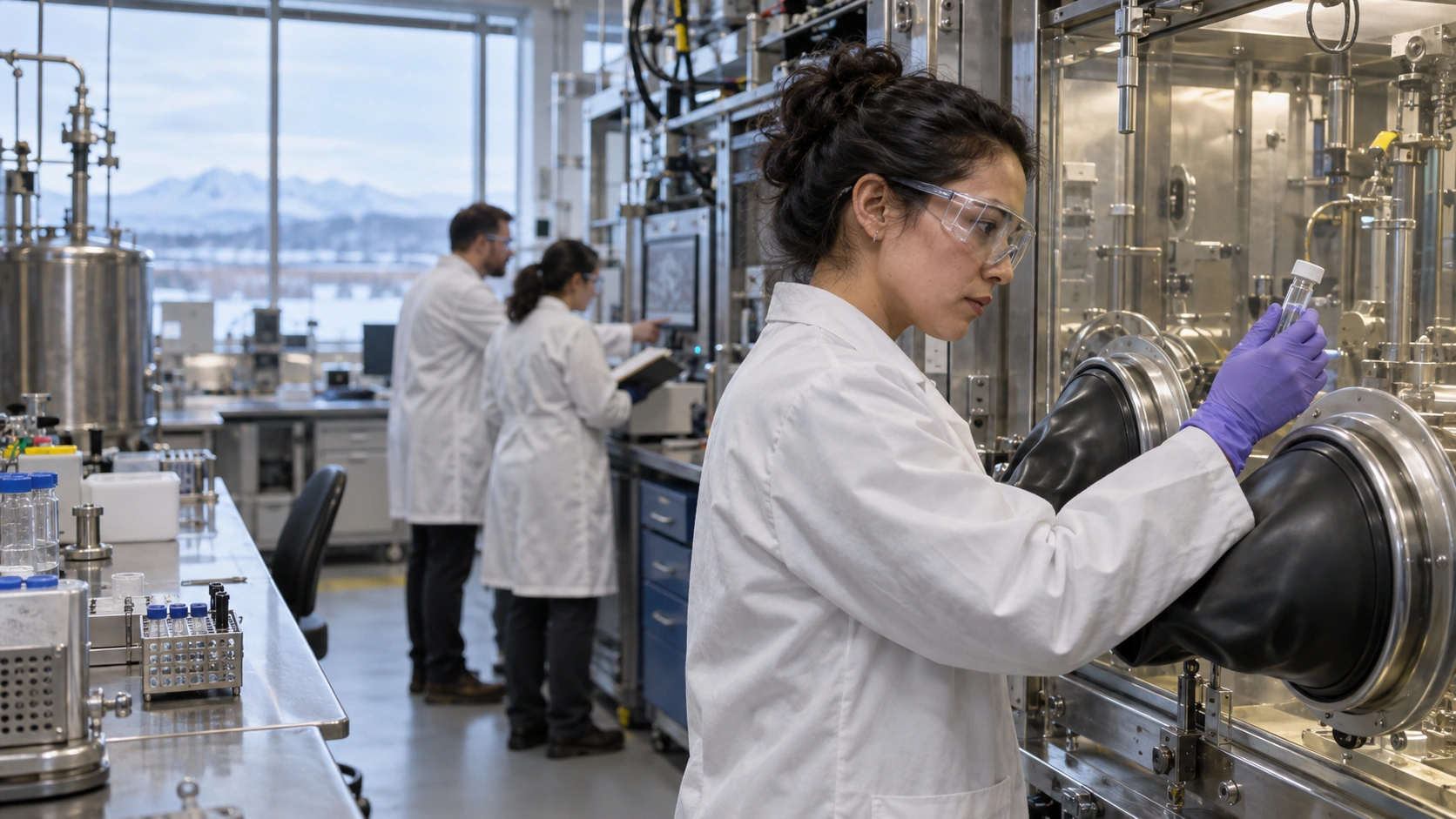
Researchers work with shielded radiochemistry equipment in a modern laboratory. AI-generated illustration; not a photograph of this project.
Most federal science notices arrive with a short clock and a short list of eligible institutions. This one offers a full year and names Isotope R&D and Production among its program areas, which makes it unusually relevant to teams working around radiopharmaceuticals and isotope supply.
The headline ceiling is not a promise. Applications move on topic-specific panel schedules, and those dates have not yet been extracted from the two-part notice. The practical first move is to identify the right program manager and read the panel calendar before treating the September 2027 close as working time.
Many types of organizations may apply, but three online systems stand in the way of a last-minute filing. DOE's PAMS system handles any required early application, while SAM.gov and Grants.gov are needed for the final submission. The long runway helps only if those accounts begin before the science narrative is ready.
Before you start
Applicant types are unrestricted except lobbying 501(c)(4) organizations. No faculty PI requirement was identified. Foreign work needs careful structuring.
The finer details
Read both parts of the announcement for the Isotope R&D and Production calendar. Then start DOE's PAMS registration and complete SAM.gov and Grants.gov setup.
OPEN / United States, Regions 1, 3 and 4; region-specific service areas
One program, three very different maps
1 min read ·
USDOT opened one award each in Regions 1, 3 and 4. The amounts, match rules and service areas differ, so each record must be read on its own.
U.S. Department of Transportation · Small Business Transportation Technical Assistance Center, Regions 1, 3 and 4
Small transportation-business owners and advisors compare operating materials around a worktable. AI-generated illustration; not a photograph of this project.
Federal programs often repeat a title across regions, which makes a tidy table tempting. Here, tidy would be wrong. The three live records carry different exact award amounts, and the official match flags are not the same.
Region 1 lists $377,016 and Region 3 lists $231,183. Region 4 lists $250,143.33 and covers a nine-state area. Each record anticipates one award, so the relevant question is not which number looks best. It is whether the applicant can credibly serve the named region.
The October 31 close gives a national audience a little room, but the official summary does not print a closing hour. Calendar entries should remain all-day until the full instructions supply one.
Before you start
Eligibility and service geography differ by region. Region 4 covers Alabama, Arkansas, Illinois, Iowa, Kentucky, Mississippi, Missouri, Nebraska and Tennessee. Washington eligibility is not implied.
The finer details
Choose the actual service region before drafting. Confirm the regional match rule and applicant terms in the corresponding official record.
Exact regional eligibility and match terms require record-by-record reading. The direct Region 3 and Region 4 records are linked below.
Seattle offers up to $45,000 for digital-equity projects inside city limits, with a confirmed 25 percent community match.
City of Seattle · Technology Matching Fund 2026-2027
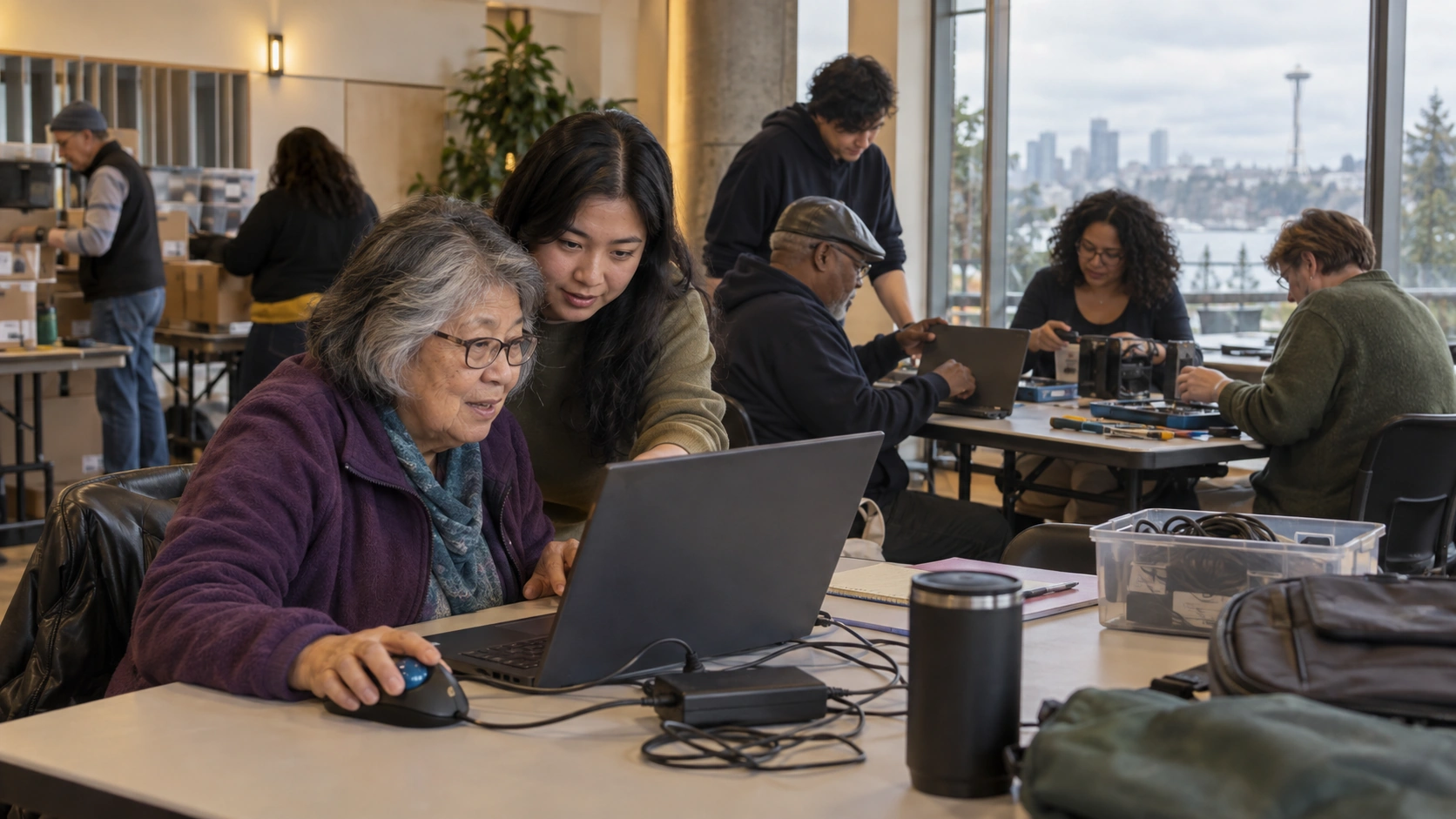
Community members and volunteers work with laptops and refurbished devices in a neighborhood technology workshop. AI-generated illustration; not a photograph of this project.
The useful thing about a January deadline is the work it allows in October. Seattle teams have time to shape a digital equity project with the people it is meant to serve instead of assembling community support after the idea is already fixed.
The grant offers up to $45,000 and allows a 12-month project. Its 25 percent community match must be confirmed, which turns early conversations, partner commitments and in-kind contributions into part of the application rather than decoration around it.
A November 17 draft review creates a second planning date well before the final filing. The published 5:00 p.m. deadline does not state a time zone, so the date should remain all-day on a reader calendar until the city clarifies it.
Before you start
Project activity must occur within Seattle city limits. One application per organization. Fiscal sponsorship is permitted.
The finer details
Start match letters before the portal opens. The optional draft review deadline is 17 November 2026.
The published final deadline does not state a time zone.
WSMA offers fifteen $10,000 awards, but every application needs two to five real partners, BizLink readiness and a plan to reach at least 35 Washington businesses.
Washington State Microenterprise Association · 2026-2027 Statewide Collaborative Projects Grant
Business-support partners review a collaborative project checklist around a community-office table. AI-generated illustration; not a photograph of this project.
A $10,000 award can look like a quick application. It is not. WSMA requires a lead with at least two years of business-assistance experience, two to five strategic partners, and a plan to serve at least 35 unduplicated Washington businesses.
Organizations familiar with WSMA may know the forms, but this year’s team still has to exist on paper and in practice. Every partner must be enrolled or submitted in Evergreen BizLink, the W-9 must be dated 2026, and the Fund Request Form must remain in Excel.
A history of three funded cycles makes the opportunity unusually relevant. It does not shorten the current partner and attachment checklist. The seven-business-day window after publication is a go-or-stop decision, not an invitation to rush.
Before you start
A lead organization must bring two to five strategic partners. Every partner must be enrolled or submitted in Evergreen BizLink. The lead needs two years of comprehensive business training or technical-assistance experience, and the project must serve at least 35 Washington businesses.
The finer details
Recruit the collaborative, verify every BizLink profile and assemble the 2026 W-9 and Excel-only Fund Request Form.
Issuer labels the time PST, while the October date falls in PDT. Use 5:00 p.m. Pacific local.
Humanity AI offers $75,000 to $1 million for work that gives U.S. communities real influence over how AI affects work, education, culture and everyday life.
Humanity AI · Communities Leading on AI Open Call
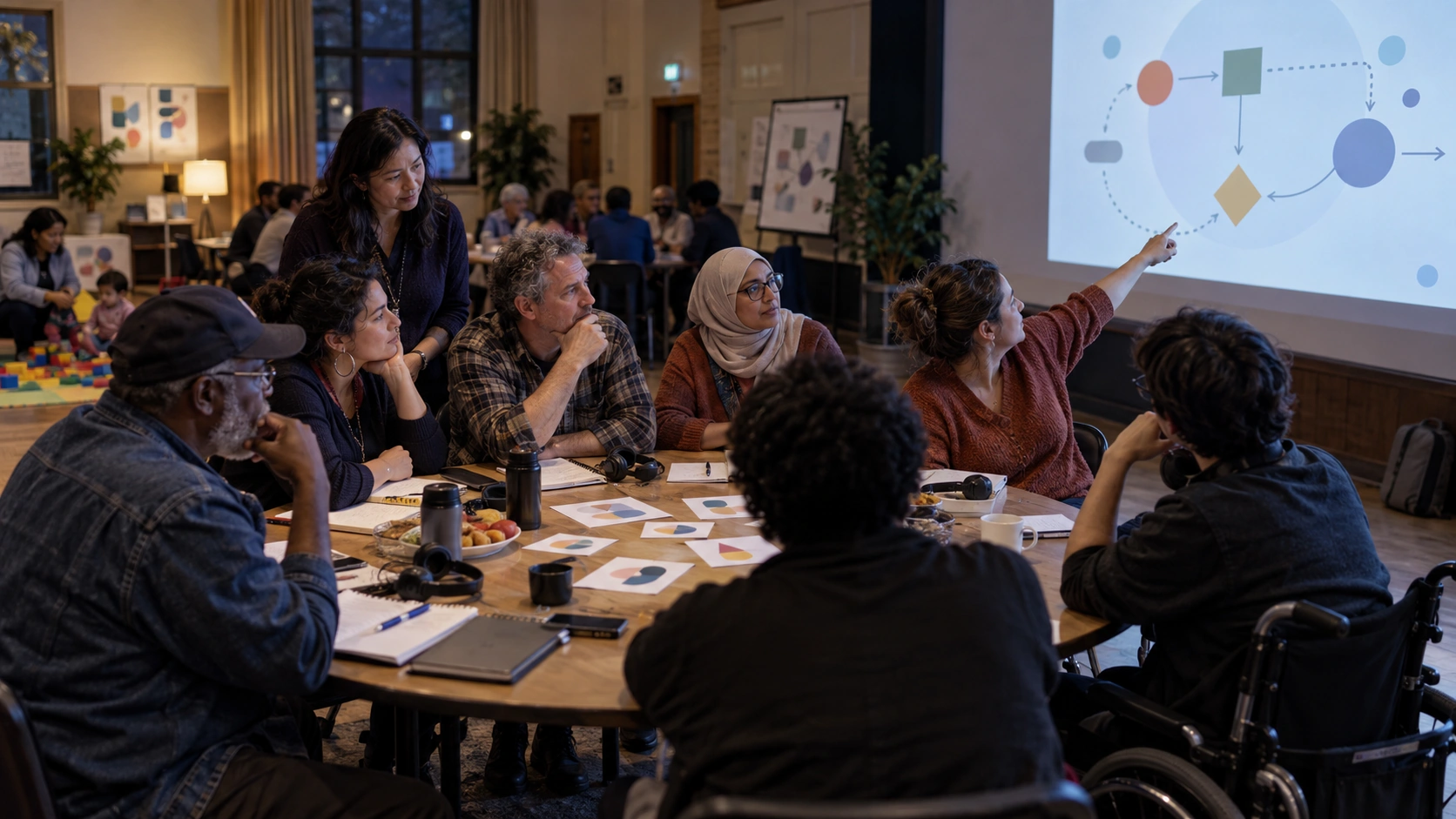
Four community participants discuss ideas around a laptop and meeting table. AI-generated illustration; not a photograph of this project.
At the top tier, Humanity AI will award up to $1 million for work that gives U.S. communities real influence over how AI is built and used. Smaller awards begin at $75,000, with $10 million available across the program.
The fund is looking for communities to shape how AI affects education, work, economic life and culture. Literacy programs or technology adoption alone do not meet that ambition. The proposal needs a community-led approach with power, governance or design inside it.
The close falls ten business days after publication. A downloadable question set and webinar reduce drafting uncertainty, but the team still needs to choose the frame before it can use them well.
Before you start
Lead applicant must be a U.S.-based 501(c)(3) and the work must focus on U.S. communities. For-profits may participate but cannot lead. 2026 grantees cannot apply as sole applicants.
The finer details
Choose the primary frame, with labor and economy the clearest match to the documented record, then draft to the published question set.
OPEN / United States; Native American health focus
One registration stands between a strong fit and a closed door
1 min read ·
NIH’s Native American Health R34 and R01 close October 21 on their final receipt date, and eRA Commons registration must already be complete to submit.
National Institutes of Health · PAR-25-378 and PAR-25-379, Intervention Research to Improve Native American Health
Community members and health professionals co-design a care pathway in a contemporary rural clinic meeting room. AI-generated illustration; not a photograph of this project.
A deadline can be accurate and still be unavailable. These NIH calls accept nonprofit and community-based applicants, offer both planning-grant and full-research routes, and close October 21. The administrative account behind the filing often takes longer than the remaining calendar.
The R34 offers up to $450,000 in direct costs across three years. Its companion R01 supports a full research project, with no preset budget ceiling and a five-year maximum. Both focus on intervention research intended to improve Native American health.
October 21 is the final listed receipt date under both announcements before they expire in January. Applicants without active eRA Commons registration should treat that system gate as the deciding fact and protect later NIH opportunities by starting it now.
Before you start
U.S. nonprofits, community-based organizations, Tribal governments and organizations, AI/AN-serving institutions and regional organizations may apply. Foreign organizations cannot lead either grant. The R01 permits foreign components; the R34 notice does not list foreign components as eligible. No cost share is required.
The finer details
Confirm active SAM.gov and institutional eRA Commons registration before deciding whether the deadline is usable. Organizations starting eRA Commons now should plan for later NIH cycles rather than promise this filing.
Registration readiness determines whether the October 21 filing is reachable. The official R01 permits foreign components, while foreign organizations cannot lead either grant.
OPEN / Pacific Northwest; see five-state and impact rules
A six-figure request needs a six-figure idea
1 min read ·
Murdock requires at least a $100,000 request inside a project budget of $200,000 or more, with the letter-of-inquiry window opening October 15.
M.J. Murdock Charitable Trust · Strategic Project Grants, Fall 2026 Letter of Inquiry Window
Nonprofit leaders study site plans, a budget worksheet and material samples for a large strategic project. AI-generated illustration; not a photograph of this project.
The arithmetic rules out a dressed-up pilot. A request must be at least $100,000 and the full project budget at least $200,000, so the proposal needs a strategic build with enough evidence and institutional commitment to justify the scale.
The geographic fit is strong for a Pacific Northwest organization, and the window provides four weeks for the letter of inquiry. The harder question is what deserves to operate at that scale. A workforce or microenterprise platform has a better claim than a loosely defined pilot. The form does not appear until the eligibility quiz is complete. Opening day is therefore an action date, not a deadline, and the issue should show both.
Before you start
Applicants must be based in Alaska, Idaho, Montana, Oregon or Washington, or deliver more than half of project impact there. Three full years of operating and financial history are required. Fiscal sponsors are not eligible.
The finer details
Complete the mandatory eligibility quiz when the window opens. It unlocks the letter-of-inquiry form.
No fixed award range beyond the minimum request and project budget was identified.
UPDATED / United States nationally, or Illinois regionally
Local insight needs a national audience
1 min read ·
RRF funds journalism, media and shared learning for people age 60 and older, but the work must reach a national audience or serve Illinois regionally.
RRF Foundation for Aging · Knowledge Sharing and Awareness Raising Grants
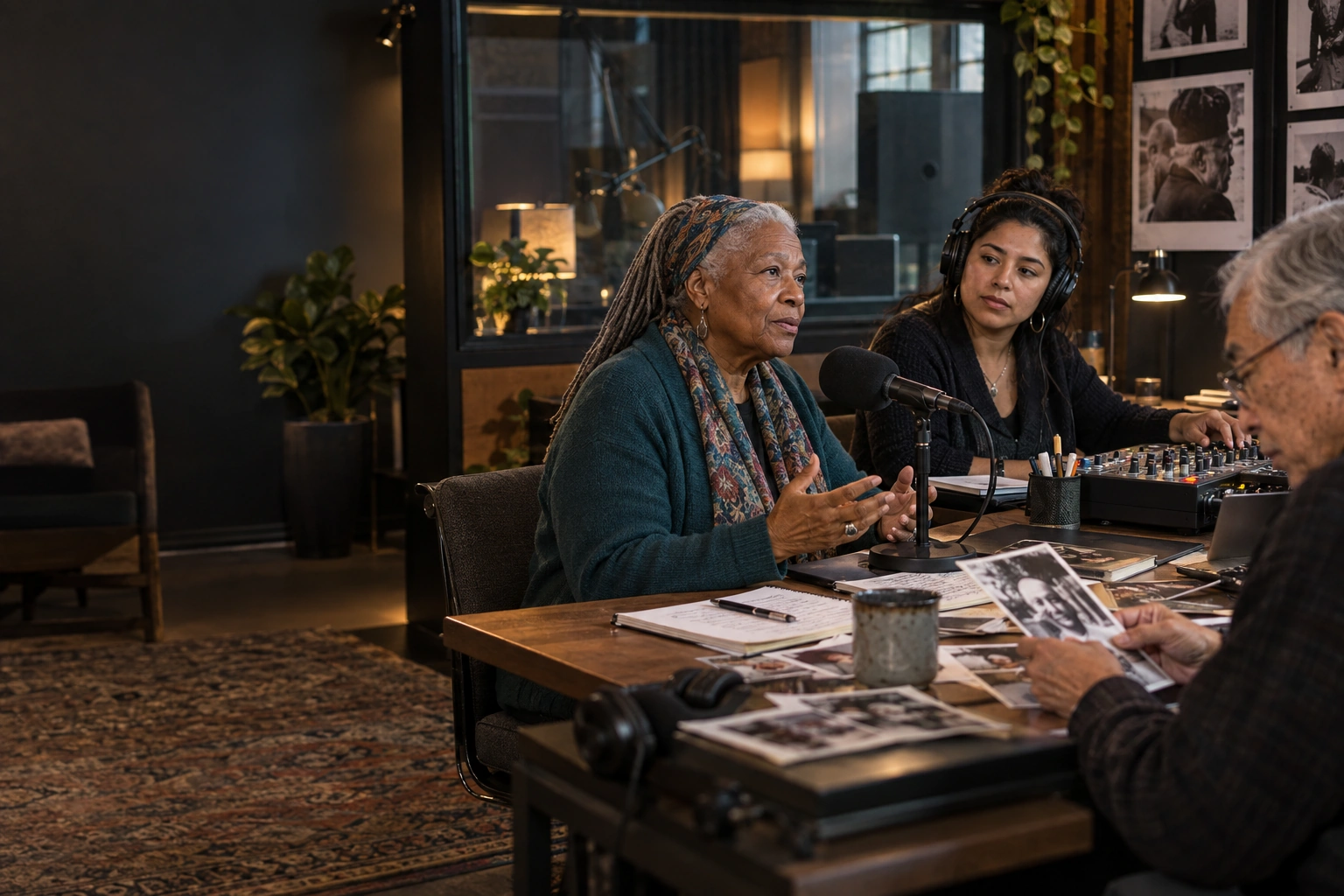
Older adults and an audio producer record a community newsroom conversation about aging. AI-generated illustration; not a photograph of this project.
Age equity, caregiving, economic security, housing and social connection are at the center of this call. RRF wants those ideas carried through journalism, media, learning communities or another form that can travel beyond a single workshop.
The grant supports journalism, media, learning communities and other forms of knowledge sharing. It is not a biomedical research grant or a general operating award, and its audience must be people age 60 and older.
The program page does not publish an award amount. That missing number belongs in the story because it affects whether a national delivery plan is realistic.
Before you start
Nonprofit applicants. Projects must intentionally focus on people age 60 and older and have national U.S. reach, or regional reach in Illinois. General operating support, institutional healthcare, biomedical research, construction and lobbying are excluded.
The finer details
Use the official eligibility quiz, then design the letter of inquiry for a national audience.
Award amount is unpublished. Program-specific and general closing-time language should be confirmed before filing.
Ten funding selections for this week. Stories distinguish eligibility, an open cycle and filing readiness. Amounts retain their qualifications, and unresolved panel dates or closing times remain visible.
THE ARKUS SIGNAL / FUNDINGTHE OPPORTUNITIES / 06
CORRECTED / Washington State
Paperwork needs a real capital project
1 min read ·
Washington nonprofits can request up to $50,000 for planning and technical help, provided there is a real early-stage capital project behind the request.
Washington State Department of Commerce · FY2027 Capital Project Capacity-Building Grant Program
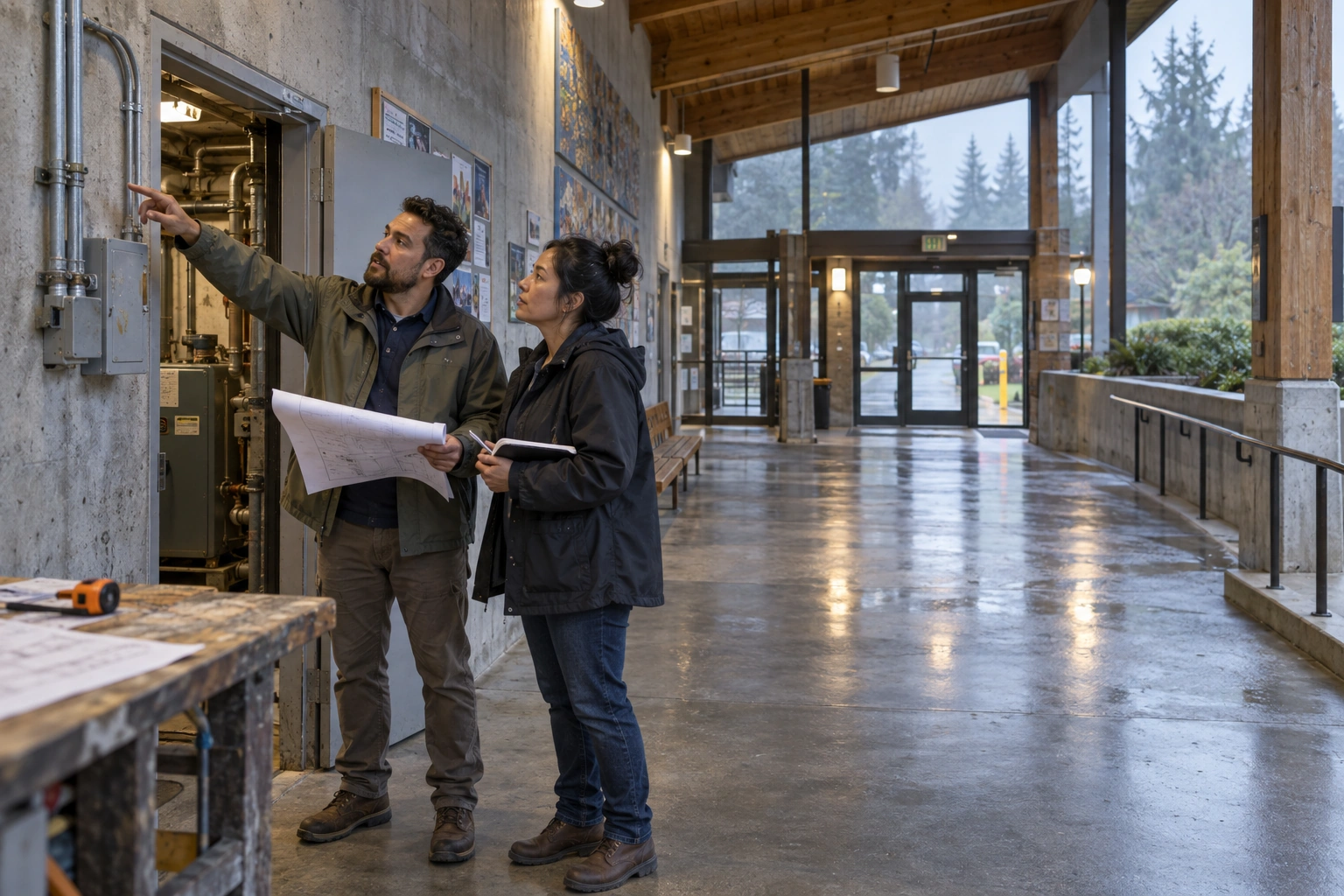
A nonprofit facilities director and infrastructure advisor inspect an older community building. AI-generated illustration; not a photograph of this project.
Many nonprofits qualify. Fewer have the right project. Commerce will pay for early planning and technical work around housing, energy or infrastructure that benefits an overburdened Washington community.
The program prioritizes housing, energy and infrastructure projects that benefit overburdened communities. That makes the award useful for planning work that often struggles to find a budget, but it does not turn an operating program into a capital project.
The questions window closes October 9, well before the October 30 application deadline. Applicants should use it to resolve any project-readiness or documentation issue now.
Before you start
Federally designated nonprofits registered in Washington are eligible. The project must benefit an overburdened Washington community. Only one application may be submitted per eligible entity.
The finer details
Confirm the applicant has an actual early-stage capital project and read the current application guide before relying on last year's conditions.
Applicants should still read the current application guide and any amendments before filing.
NCI’s IMAT program offers up to $150,000 a year for early proof of concept and up to $300,000 a year for advanced validation.
National Cancer Institute · Innovative Molecular Analysis Technologies, R61 and R33 mechanisms
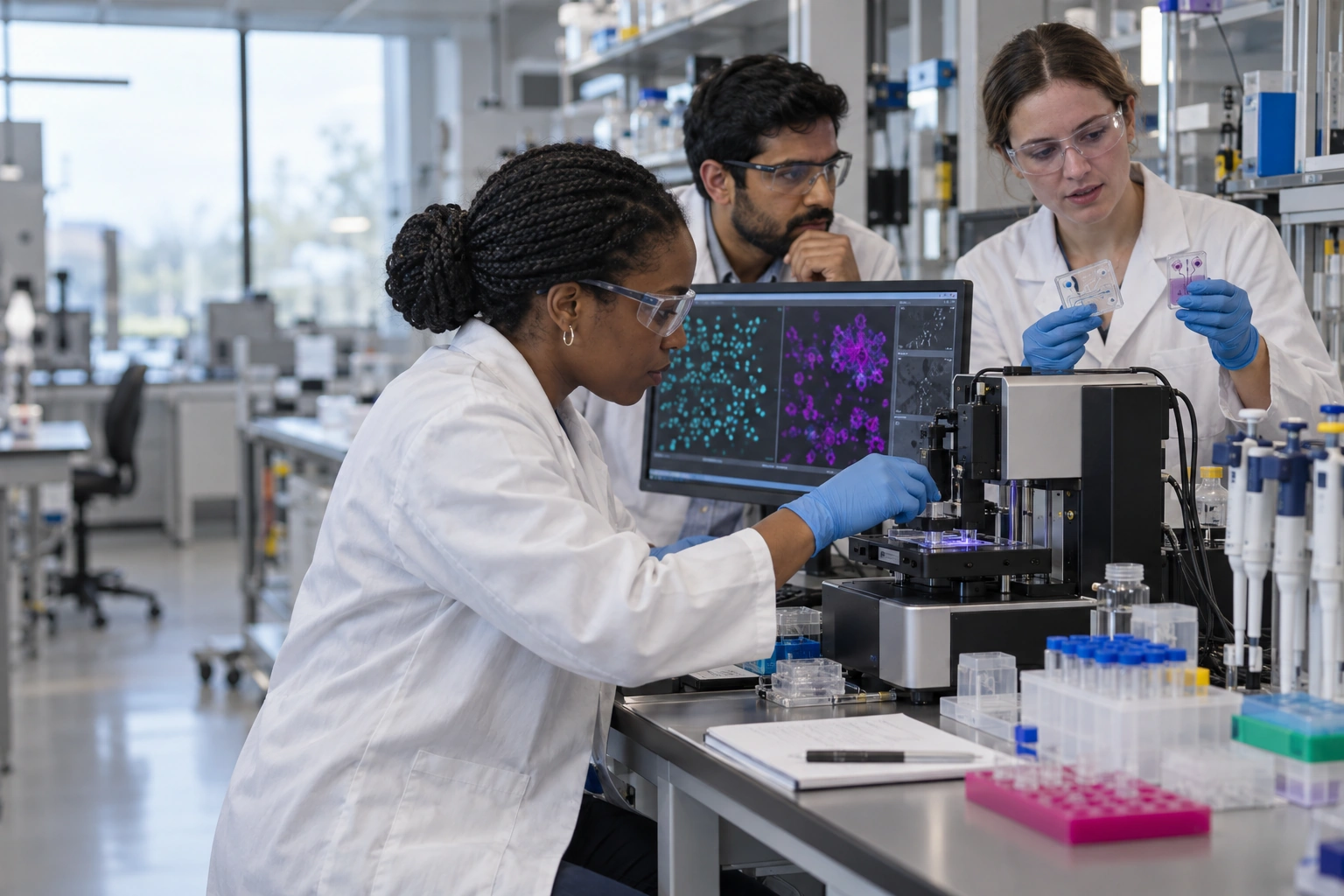
A multidisciplinary laboratory team evaluates a molecular-analysis instrument and prototype cartridges. AI-generated illustration; not a photograph of this project.
A research tool can fail before review because the team chose the wrong maturity story. IMAT separates early proof of concept from advanced development and validation, which gives applicants a clearer place to stand.
The R61 grant offers up to $150,000 in direct costs per year for three years and anticipates about 20 awards. The R33 grant doubles the annual direct-cost ceiling and anticipates about 13 awards. A prior R61 is not required for R33.
Both mechanisms close November 10 at 5:00 p.m. in the applicant organization's local time. The registration chain is long enough that scientific fit alone does not establish readiness.
Before you start
Eligible organizations include nonprofits. Clinical trials are not allowed. A prior R61 award is not required for the R33 grant.
The finer details
Choose the project's stage first, then complete SAM.gov, eRA Commons, Grants.gov and ORCID setup.
Applicants must read the separate R61 and R33 notices; the two mechanisms are not interchangeable.
THE ARKUS SIGNAL / IDEAS & EXPERIMENTSTHE OPPORTUNITIES / 07
Eligibility, cycle and readiness
A grant can fit the organization perfectly and still be closed, unreachable or waiting on a system account.
Eligibility answers one question: whether this kind of organization may apply. It does not tell you that the current round is open, that the first required step is still reachable or that the accounts needed to file are ready. Those are separate facts, and each can stop a promising proposal.
WSMA makes the distinction plain. The award is open and Arkus has a strong history with the program, but the application still needs a Washington lead, two to five qualified partners, current BizLink records and required attachments. A good record helps the case. It does not assemble this year's team.
NIH shows the sharper version. The Native health R34 may fit an eligible community and research partnership, yet October 21 is the final receipt date before the notice expires. If the institution has not completed eRA Commons registration, the window may already be out of reach even when the idea is excellent.
Opening dates deserve the same care. Seattle's Technology Matching Fund and Murdock's next inquiry window both open October 15. That date begins the filing route. It is not the deadline, and it does not erase the match letters, geography checks or internal decisions that should happen before the portal becomes busy.
A useful record therefore keeps three states in view: eligible, open and ready to file. Mark what is confirmed, assign the earliest missing step and decide whether the current round is still realistic. The first honest answer may be 'not yet.' That answer can save a week of elegant writing aimed at a locked door.
ELIGIBLEOrganization fitThe applicant type and geography fit the official rules.
OPENCurrent cycleThe round is accepting the required filing now.
FILING-READYSystems and gatesAccounts, partners and early submissions are reachable.
Research, design and operating judgment for the next practical decision.
Chandler LewisFounder · Managing DirectorWalter BenadofPartner · Global Markets and InvestmentsNadia LerougeDeputy Managing DirectorCloud (Yiyun) QiuPartner · Design and Innovation StrategyAarav GhaiResearch Analyst
Arkus Innovation Studios is a commercial advisory and venture studio for founders, investors and enterprise teams deciding what to build, improve or investigate. We turn broad questions into a defined piece of work, examine the available evidence and help the team make a practical next decision.
Our work includes Startup Diagnostics, Portfolio Diagnostics, AI Workflow Sprints and enterprise assessments. The Innovation Compass gives assessment work its structure. The Teixeira Framework organizes four possible recommendations: Accelerate, Incubate, Develop or Watch. A recommendation is useful when its reasoning, assumptions and next test are clear enough for the team to use. We combine research, operating experience, design and commercial judgment.
That can mean checking a market claim, examining a technology's limits, testing an AI workflow or organizing the evidence needed for a proposal. We define responsibilities before beginning and keep the proposed outcome connected to the question the client needs answered. Arkus is the commercial studio; 360 Social Impact Studios and Enough Ventures are separate organizations with different legal structures.
If an opportunity in this issue connects with your work, send the public call, a brief description of your idea or capabilities and the role you have in mind. Where eligibility and agreed responsibilities permit, Arkus can discuss leading or joining the work. Contact Nadia Lerouge through the invitation below to begin that conversation.
An Arkus Innovation Studios publicationPeople & possibilities
The Arkus Signal
Grants and funding opportunities worth pursuing
FUNDING EDITION7 OCTOBER 2026ISSUE 04 / PRINT EDITION
Grants & research funding
The application begins before the writing.
WSMA offers fifteen $10,000 awards, but every application needs two to five real partners, BizLink readiness and a plan to reach at least 35 Washington businesses.
Business-support partners review a collaborative project checklist around a community-office table. AI-generated illustration; not a photograph of this project.
The WSMA award is modest by grant standards and demanding by design. Every applicant needs a Washington lead, two to five qualified partners, current BizLink records, and a plan to reach at least 35 businesses.
Inside: ten funding stories. Three calls are new or reopened, while the rest earned their place through deadline pressure, corrected eligibility or clear strategic fit.
Reachable means ready
Two kinds of runway.
Choose a call to see what must exist before filing.
Washington State Microenterprise Association
Build the collaborative first.
Recruit the collaborative, verify every BizLink profile and assemble the 2026 W-9 and Excel-only Fund Request Form.
Read both parts of the announcement for the Isotope R&D and Production calendar. Then start DOE's PAMS registration and complete SAM.gov and Grants.gov setup.
$5,000 floor, $10 million ceiling, $400 million total program funding30 September 2027 · 11:59 p.m. ETRules & application steps ↗
AI-generated editorial scenes. WSMA requires a real partner structure and current records. DOE remains open longer, but topic panel dates may control earlier action.Explore the opportunities ↓
THE ARKUS SIGNAL / FUNDINGTHE OPPORTUNITIES / 02
OPEN / United States; foreign work requires careful structuring
Isotope science gets a year-long runway
1 min read ·
DOE’s $400 million Office of Science program names isotope research, but applicants must find the right panel date before treating September 2027 as the deadline.
U.S. Department of Energy, Office of Science · FY2027 Continuation of Solicitation for the Office of Science Financial Assistance Program, DE-FOA-0003665
Researchers work with shielded radiochemistry equipment in a modern laboratory. AI-generated illustration; not a photograph of this project.
Most federal science notices arrive with a short clock and a short list of eligible institutions. This one offers a full year and names Isotope R&D and Production among its program areas, which makes it unusually relevant to teams working around radiopharmaceuticals and isotope supply.
The headline ceiling is not a promise. Applications move on topic-specific panel schedules, and those dates have not yet been extracted from the two-part notice. The practical first move is to identify the right program manager and read the panel calendar before treating the September 2027 close as working time.
Many types of organizations may apply, but three online systems stand in the way of a last-minute filing. DOE's PAMS system handles any required early application, while SAM.gov and Grants.gov are needed for the final submission. The long runway helps only if those accounts begin before the science narrative is ready.
Before you start
Applicant types are unrestricted except lobbying 501(c)(4) organizations. No faculty PI requirement was identified. Foreign work needs careful structuring.
The finer details
Read both parts of the announcement for the Isotope R&D and Production calendar. Then start DOE's PAMS registration and complete SAM.gov and Grants.gov setup.
OPEN / United States, Regions 1, 3 and 4; region-specific service areas
One program, three very different maps
1 min read ·
USDOT opened one award each in Regions 1, 3 and 4. The amounts, match rules and service areas differ, so each record must be read on its own.
U.S. Department of Transportation · Small Business Transportation Technical Assistance Center, Regions 1, 3 and 4
Small transportation-business owners and advisors compare operating materials around a worktable. AI-generated illustration; not a photograph of this project.
Federal programs often repeat a title across regions, which makes a tidy table tempting. Here, tidy would be wrong. The three live records carry different exact award amounts, and the official match flags are not the same.
Region 1 lists $377,016 and Region 3 lists $231,183. Region 4 lists $250,143.33 and covers a nine-state area. Each record anticipates one award, so the relevant question is not which number looks best. It is whether the applicant can credibly serve the named region.
The October 31 close gives a national audience a little room, but the official summary does not print a closing hour. Calendar entries should remain all-day until the full instructions supply one.
Before you start
Eligibility and service geography differ by region. Region 4 covers Alabama, Arkansas, Illinois, Iowa, Kentucky, Mississippi, Missouri, Nebraska and Tennessee. Washington eligibility is not implied.
The finer details
Choose the actual service region before drafting. Confirm the regional match rule and applicant terms in the corresponding official record.
Exact regional eligibility and match terms require record-by-record reading. The direct Region 3 and Region 4 records are linked below.
Seattle offers up to $45,000 for digital-equity projects inside city limits, with a confirmed 25 percent community match.
City of Seattle · Technology Matching Fund 2026-2027
Community members and volunteers work with laptops and refurbished devices in a neighborhood technology workshop. AI-generated illustration; not a photograph of this project.
The useful thing about a January deadline is the work it allows in October. Seattle teams have time to shape a digital equity project with the people it is meant to serve instead of assembling community support after the idea is already fixed.
The grant offers up to $45,000 and allows a 12-month project. Its 25 percent community match must be confirmed, which turns early conversations, partner commitments and in-kind contributions into part of the application rather than decoration around it.
A November 17 draft review creates a second planning date well before the final filing. The published 5:00 p.m. deadline does not state a time zone, so the date should remain all-day on a reader calendar until the city clarifies it.
Before you start
Project activity must occur within Seattle city limits. One application per organization. Fiscal sponsorship is permitted.
The finer details
Start match letters before the portal opens. The optional draft review deadline is 17 November 2026.
The published final deadline does not state a time zone.
WSMA offers fifteen $10,000 awards, but every application needs two to five real partners, BizLink readiness and a plan to reach at least 35 Washington businesses.
Washington State Microenterprise Association · 2026-2027 Statewide Collaborative Projects Grant
Business-support partners review a collaborative project checklist around a community-office table. AI-generated illustration; not a photograph of this project.
A $10,000 award can look like a quick application. It is not. WSMA requires a lead with at least two years of business-assistance experience, two to five strategic partners, and a plan to serve at least 35 unduplicated Washington businesses.
Organizations familiar with WSMA may know the forms, but this year’s team still has to exist on paper and in practice. Every partner must be enrolled or submitted in Evergreen BizLink, the W-9 must be dated 2026, and the Fund Request Form must remain in Excel.
A history of three funded cycles makes the opportunity unusually relevant. It does not shorten the current partner and attachment checklist. The seven-business-day window after publication is a go-or-stop decision, not an invitation to rush.
Before you start
A lead organization must bring two to five strategic partners. Every partner must be enrolled or submitted in Evergreen BizLink. The lead needs two years of comprehensive business training or technical-assistance experience, and the project must serve at least 35 Washington businesses.
The finer details
Recruit the collaborative, verify every BizLink profile and assemble the 2026 W-9 and Excel-only Fund Request Form.
Issuer labels the time PST, while the October date falls in PDT. Use 5:00 p.m. Pacific local.
Humanity AI offers $75,000 to $1 million for work that gives U.S. communities real influence over how AI affects work, education, culture and everyday life.
Humanity AI · Communities Leading on AI Open Call
Four community participants discuss ideas around a laptop and meeting table. AI-generated illustration; not a photograph of this project.
At the top tier, Humanity AI will award up to $1 million for work that gives U.S. communities real influence over how AI is built and used. Smaller awards begin at $75,000, with $10 million available across the program.
The fund is looking for communities to shape how AI affects education, work, economic life and culture. Literacy programs or technology adoption alone do not meet that ambition. The proposal needs a community-led approach with power, governance or design inside it.
The close falls ten business days after publication. A downloadable question set and webinar reduce drafting uncertainty, but the team still needs to choose the frame before it can use them well.
Before you start
Lead applicant must be a U.S.-based 501(c)(3) and the work must focus on U.S. communities. For-profits may participate but cannot lead. 2026 grantees cannot apply as sole applicants.
The finer details
Choose the primary frame, with labor and economy the clearest match to the documented record, then draft to the published question set.
OPEN / United States; Native American health focus
One registration stands between a strong fit and a closed door
1 min read ·
NIH’s Native American Health R34 and R01 close October 21 on their final receipt date, and eRA Commons registration must already be complete to submit.
National Institutes of Health · PAR-25-378 and PAR-25-379, Intervention Research to Improve Native American Health
Community members and health professionals co-design a care pathway in a contemporary rural clinic meeting room. AI-generated illustration; not a photograph of this project.
A deadline can be accurate and still be unavailable. These NIH calls accept nonprofit and community-based applicants, offer both planning-grant and full-research routes, and close October 21. The administrative account behind the filing often takes longer than the remaining calendar.
The R34 offers up to $450,000 in direct costs across three years. Its companion R01 supports a full research project, with no preset budget ceiling and a five-year maximum. Both focus on intervention research intended to improve Native American health.
October 21 is the final listed receipt date under both announcements before they expire in January. Applicants without active eRA Commons registration should treat that system gate as the deciding fact and protect later NIH opportunities by starting it now.
Before you start
U.S. nonprofits, community-based organizations, Tribal governments and organizations, AI/AN-serving institutions and regional organizations may apply. Foreign organizations cannot lead either grant. The R01 permits foreign components; the R34 notice does not list foreign components as eligible. No cost share is required.
The finer details
Confirm active SAM.gov and institutional eRA Commons registration before deciding whether the deadline is usable. Organizations starting eRA Commons now should plan for later NIH cycles rather than promise this filing.
Registration readiness determines whether the October 21 filing is reachable. The official R01 permits foreign components, while foreign organizations cannot lead either grant.
OPEN / Pacific Northwest; see five-state and impact rules
A six-figure request needs a six-figure idea
1 min read ·
Murdock requires at least a $100,000 request inside a project budget of $200,000 or more, with the letter-of-inquiry window opening October 15.
M.J. Murdock Charitable Trust · Strategic Project Grants, Fall 2026 Letter of Inquiry Window
Nonprofit leaders study site plans, a budget worksheet and material samples for a large strategic project. AI-generated illustration; not a photograph of this project.
The arithmetic rules out a dressed-up pilot. A request must be at least $100,000 and the full project budget at least $200,000, so the proposal needs a strategic build with enough evidence and institutional commitment to justify the scale.
The geographic fit is strong for a Pacific Northwest organization, and the window provides four weeks for the letter of inquiry. The harder question is what deserves to operate at that scale. A workforce or microenterprise platform has a better claim than a loosely defined pilot. The form does not appear until the eligibility quiz is complete. Opening day is therefore an action date, not a deadline, and the issue should show both.
Before you start
Applicants must be based in Alaska, Idaho, Montana, Oregon or Washington, or deliver more than half of project impact there. Three full years of operating and financial history are required. Fiscal sponsors are not eligible.
The finer details
Complete the mandatory eligibility quiz when the window opens. It unlocks the letter-of-inquiry form.
No fixed award range beyond the minimum request and project budget was identified.
UPDATED / United States nationally, or Illinois regionally
Local insight needs a national audience
1 min read ·
RRF funds journalism, media and shared learning for people age 60 and older, but the work must reach a national audience or serve Illinois regionally.
RRF Foundation for Aging · Knowledge Sharing and Awareness Raising Grants
Older adults and an audio producer record a community newsroom conversation about aging. AI-generated illustration; not a photograph of this project.
Age equity, caregiving, economic security, housing and social connection are at the center of this call. RRF wants those ideas carried through journalism, media, learning communities or another form that can travel beyond a single workshop.
The grant supports journalism, media, learning communities and other forms of knowledge sharing. It is not a biomedical research grant or a general operating award, and its audience must be people age 60 and older.
The program page does not publish an award amount. That missing number belongs in the story because it affects whether a national delivery plan is realistic.
Before you start
Nonprofit applicants. Projects must intentionally focus on people age 60 and older and have national U.S. reach, or regional reach in Illinois. General operating support, institutional healthcare, biomedical research, construction and lobbying are excluded.
The finer details
Use the official eligibility quiz, then design the letter of inquiry for a national audience.
Award amount is unpublished. Program-specific and general closing-time language should be confirmed before filing.
Ten funding selections for this week. Stories distinguish eligibility, an open cycle and filing readiness. Amounts retain their qualifications, and unresolved panel dates or closing times remain visible.
THE ARKUS SIGNAL / FUNDINGTHE OPPORTUNITIES / 06
CORRECTED / Washington State
Paperwork needs a real capital project
1 min read ·
Washington nonprofits can request up to $50,000 for planning and technical help, provided there is a real early-stage capital project behind the request.
Washington State Department of Commerce · FY2027 Capital Project Capacity-Building Grant Program
A nonprofit facilities director and infrastructure advisor inspect an older community building. AI-generated illustration; not a photograph of this project.
Many nonprofits qualify. Fewer have the right project. Commerce will pay for early planning and technical work around housing, energy or infrastructure that benefits an overburdened Washington community.
The program prioritizes housing, energy and infrastructure projects that benefit overburdened communities. That makes the award useful for planning work that often struggles to find a budget, but it does not turn an operating program into a capital project.
The questions window closes October 9, well before the October 30 application deadline. Applicants should use it to resolve any project-readiness or documentation issue now.
Before you start
Federally designated nonprofits registered in Washington are eligible. The project must benefit an overburdened Washington community. Only one application may be submitted per eligible entity.
The finer details
Confirm the applicant has an actual early-stage capital project and read the current application guide before relying on last year's conditions.
Applicants should still read the current application guide and any amendments before filing.
NCI’s IMAT program offers up to $150,000 a year for early proof of concept and up to $300,000 a year for advanced validation.
National Cancer Institute · Innovative Molecular Analysis Technologies, R61 and R33 mechanisms
A multidisciplinary laboratory team evaluates a molecular-analysis instrument and prototype cartridges. AI-generated illustration; not a photograph of this project.
A research tool can fail before review because the team chose the wrong maturity story. IMAT separates early proof of concept from advanced development and validation, which gives applicants a clearer place to stand.
The R61 grant offers up to $150,000 in direct costs per year for three years and anticipates about 20 awards. The R33 grant doubles the annual direct-cost ceiling and anticipates about 13 awards. A prior R61 is not required for R33.
Both mechanisms close November 10 at 5:00 p.m. in the applicant organization's local time. The registration chain is long enough that scientific fit alone does not establish readiness.
Before you start
Eligible organizations include nonprofits. Clinical trials are not allowed. A prior R61 award is not required for the R33 grant.
The finer details
Choose the project's stage first, then complete SAM.gov, eRA Commons, Grants.gov and ORCID setup.
Applicants must read the separate R61 and R33 notices; the two mechanisms are not interchangeable.
THE ARKUS SIGNAL / IDEAS & EXPERIMENTSTHE OPPORTUNITIES / 07
Eligibility, cycle and readiness
A grant can fit the organization perfectly and still be closed, unreachable or waiting on a system account.
Eligibility answers one question: whether this kind of organization may apply. It does not tell you that the current round is open, that the first required step is still reachable or that the accounts needed to file are ready. Those are separate facts, and each can stop a promising proposal.
WSMA makes the distinction plain. The award is open and Arkus has a strong history with the program, but the application still needs a Washington lead, two to five qualified partners, current BizLink records and required attachments. A good record helps the case. It does not assemble this year's team.
NIH shows the sharper version. The Native health R34 may fit an eligible community and research partnership, yet October 21 is the final receipt date before the notice expires. If the institution has not completed eRA Commons registration, the window may already be out of reach even when the idea is excellent.
Opening dates deserve the same care. Seattle's Technology Matching Fund and Murdock's next inquiry window both open October 15. That date begins the filing route. It is not the deadline, and it does not erase the match letters, geography checks or internal decisions that should happen before the portal becomes busy.
A useful record therefore keeps three states in view: eligible, open and ready to file. Mark what is confirmed, assign the earliest missing step and decide whether the current round is still realistic. The first honest answer may be 'not yet.' That answer can save a week of elegant writing aimed at a locked door.
ELIGIBLEOrganization fitThe applicant type and geography fit the official rules.
OPENCurrent cycleThe round is accepting the required filing now.
FILING-READYSystems and gatesAccounts, partners and early submissions are reachable.
Research, design and operating judgment for the next practical decision.
Chandler LewisFounder · Managing DirectorWalter BenadofPartner · Global Markets and InvestmentsNadia LerougeDeputy Managing DirectorCloud (Yiyun) QiuPartner · Design and Innovation StrategyAarav GhaiResearch Analyst
Arkus Innovation Studios is a commercial advisory and venture studio for founders, investors and enterprise teams deciding what to build, improve or investigate. We turn broad questions into a defined piece of work, examine the available evidence and help the team make a practical next decision.
Our work includes Startup Diagnostics, Portfolio Diagnostics, AI Workflow Sprints and enterprise assessments. The Innovation Compass gives assessment work its structure. The Teixeira Framework organizes four possible recommendations: Accelerate, Incubate, Develop or Watch. A recommendation is useful when its reasoning, assumptions and next test are clear enough for the team to use. We combine research, operating experience, design and commercial judgment.
That can mean checking a market claim, examining a technology's limits, testing an AI workflow or organizing the evidence needed for a proposal. We define responsibilities before beginning and keep the proposed outcome connected to the question the client needs answered. Arkus is the commercial studio; 360 Social Impact Studios and Enough Ventures are separate organizations with different legal structures.
If an opportunity in this issue connects with your work, send the public call, a brief description of your idea or capabilities and the role you have in mind. Where eligibility and agreed responsibilities permit, Arkus can discuss leading or joining the work. Contact Nadia Lerouge through the invitation below to begin that conversation.