An Arkus Innovation Studios publicationPeople & possibilities
The Arkus Signal
Grants and funding opportunities worth pursuing
FUNDING EDITION14 OCTOBER 2026ISSUE 05
Grants & research funding
The viruses that quietly live with us
An October 8 reissue offers small research grants to understand the healthy human virome. The current deadline is November 10, with an unexplained later date in the notice.
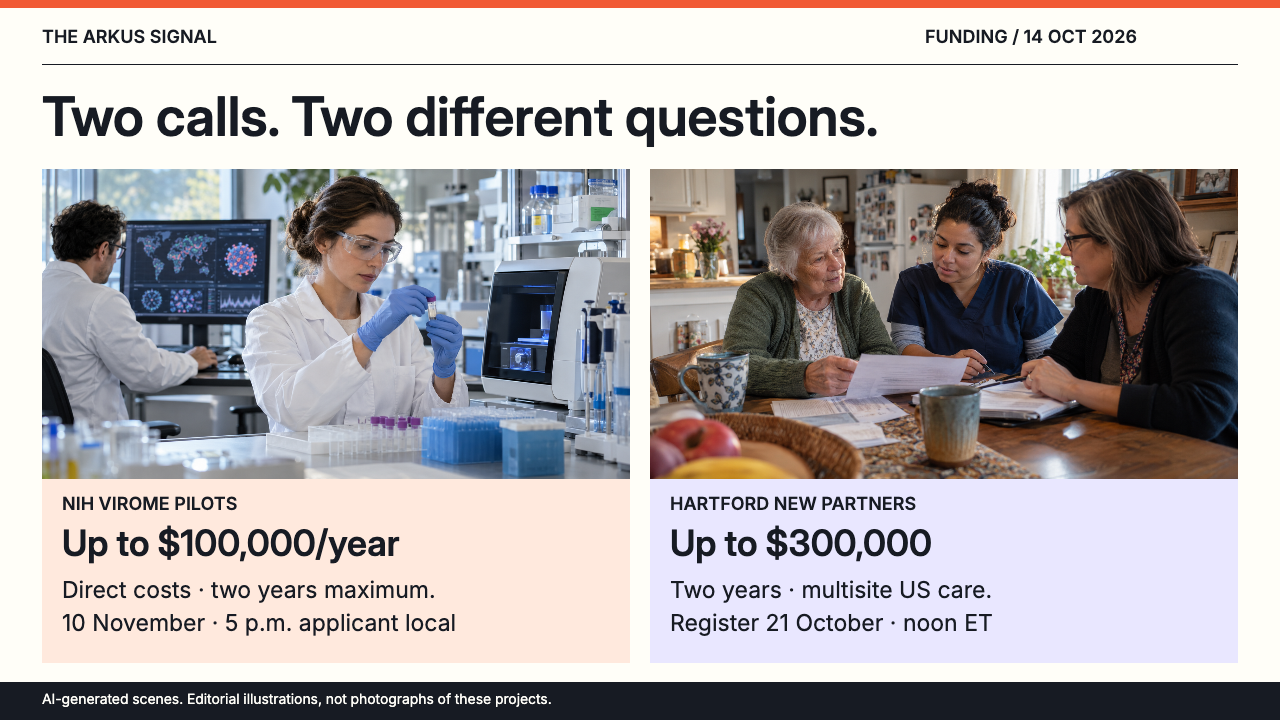
A scientist inspects carefully labeled biological specimen tubes and a sequencing workstation in a bright laboratory. AI-generated illustration; not a photograph of this project.
Not every virus in the human body announces itself with an illness. NIH’s Human Virome Program studies the viral communities that normally live in and on us, and the tools needed to understand them. Its newly reissued pilot call invites researchers outside the existing consortium to contribute distinct work.
Inside: twelve funding stories, with checked official notices, useful repeat coverage and clear first steps. New features and newly issued calls are identified separately.
Read the opening condition
Two grants. Two different first steps.
Choose a call to see its first step.
NIH Common Fund, administered by NIDCR
Map the viruses that live within.
NIH funds small studies that could open a path toward mapping the human virome. The award covers direct costs; the proposal date uses the applicant organization’s local time.
Hartford seeks new partners with national or multi-site aging-care projects. Read the prior-grant rule and complete portal registration by the safe October 21 early gate before the October 27 inquiry.
Generated editorial scenes. NIH’s pilot supports research; Hartford’s program supports aging care. Each has its own eligibility and first step. Read the full notices.Read the story ↗
THE ARKUS SIGNAL / FUNDINGTHE OPPORTUNITIES / 02
OPEN · REISSUED 8 OCTOBER / US applicants; international work follows the notice
The viruses that quietly live with us
1 min read ·
An October 8 reissue offers small research grants to understand the healthy human virome. The current deadline is November 10, with an unexplained later date in the notice.
NIH Common Fund, administered by NIDCR · Pilot Projects to Enhance the Human Virome Program (R03 Clinical Trials Not Allowed), RFA-RM-27-024
A scientist inspects carefully labeled biological specimen tubes and a sequencing workstation in a bright laboratory. AI-generated illustration; not a photograph of this project.
Not every virus in the human body announces itself with an illness. NIH’s Human Virome Program studies the viral communities that normally live in and on us, and the tools needed to understand them. Its newly reissued pilot call invites researchers outside the existing consortium to contribute distinct work.
The award allows up to $100,000 in direct costs per year for a maximum of two years, with both years’ funds paid in the first year. Projects can improve assays, methods or models, or extend suitable sampling. Clinical trials are excluded. A credible pilot needs a clear connection to the program, rather than a general interest in viruses.
The current receipt date is November 10 at 5 p.m. in the applicant organization’s local time. Start institutional and investigator registrations now. The notice also prints an October 2027 date after its stated expiration; treat that future cycle as unconfirmed. Domestic nonprofits and other listed US entities can apply; foreign applicants and funded foreign subawards cannot.
Before you start
Listed US institutions, nonprofits, businesses and public entities may apply. Foreign organizations and non-US components cannot apply; foreign components are allowed, but foreign subawards/subcontracts are prohibited. No cost share.
The finer details
Complete SAM/UEI, Grants.gov and eRA Commons registrations, including signing-official and investigator accounts. Work must extend the Human Virome Program; clinical trials are excluded.
US applicants; permitted international collaboration must follow the notice
The due-date table lists 22 October 2027 although the stated expiration is 11 November 2026. No later cycle is promised.
Grants.gov metadata says 13 expected awards; the full notice says approximately six. The full notice controls.
Organization-local time needs the reader’s organization time zone; the default reminder remains all-day.
OPEN · OLDER DISCOVERY / US national or multisite care
A new partner needs a wider map
1 min read ·
Hartford offers up to $300,000 over two years for care improvements that can travel. Register by October 21, before the October 27 letter of intent.
The John A. Hartford Foundation · JAHF New Partners Program: National Initiatives Advancing Improvements in Care for Older Adults
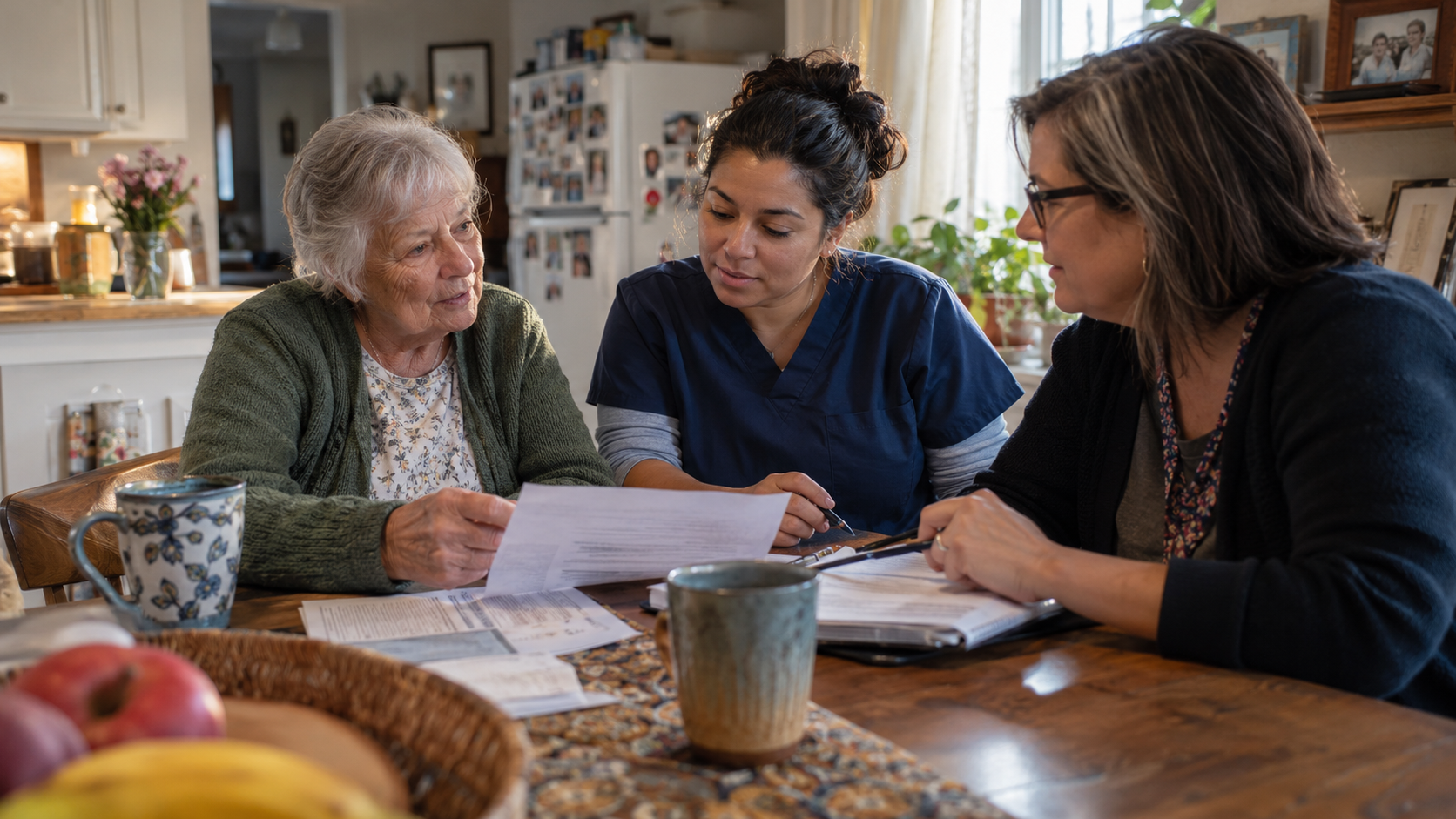
Older adults and a family caregiver review a care-planning sheet with a clinician at a welcoming community health meeting. AI-generated illustration; not a photograph of this project.
A useful improvement in older adults’ care should be able to leave the building where it began. Hartford’s New Partners Program seeks national or multisite work in age-friendly health systems, family caregiving, or serious illness and end-of-life care. A single busy service site will not meet the brief.
Up to ten grants offer as much as $300,000 over two years, including indirect costs. The October 7 FAQ defines eligible new partners as organizations, or academic departments, without a board-authorized Hartford grant in the past thirty years. Never-funded applicants receive priority. Eligible fiscal sponsors can also provide the legal and financial home for a project.
Register in the grants portal by October 21 at noon Eastern; the letter of intent, a short opening proposal, follows October 27 at noon. Financial documents accompany that first proposal. Plan to explain how older adults and caregivers shape the work, how it can spread, and what sustains it. Routine services and general operating support are excluded.
Before you start
US public charities, qualifying colleges/universities, hospitals and health care organizations; eligible 501(c)(3) fiscal sponsors are allowed. No board-authorized Hartford grant in the past 30 years; never-funded applicants receive priority. US older adults or caregivers must benefit.
The finer details
Register by 21 October noon ET, then submit the LOI with financial documents by 27 October noon ET. National or multisite scope is required. One LOI per organization, with the FAQ’s distinct academic-division exception.
US-based organizations and work benefiting older adults or caregivers in the US
The CFP and FAQ process overview give 21 October as the registration deadline; FAQ answer 25 calls that date highly recommended. Keep it as the safe early gate.
Exact original issue date was not located. A Hartford-supported research-network announcement proves the call existed by 30 September.
OPEN · OLDER DISCOVERY / US states, DC and territories
The people behind the small businesses
1 min read ·
Visa’s flexible $100,000–$250,000 grants support organizations serving operating businesses. The applicant’s annual budget must fall between $1 million and $10 million.
Visa Foundation, administered by Rockefeller Philanthropy Advisors · Visa Foundation U.S. Small Business Growth and Innovation Program
A business adviser and a small shop owner study a cash-flow notebook beside a laptop in a modest working storefront. AI-generated illustration; not a photograph of this project.
The person helping a business owner untangle a cash-flow problem also needs time, tools and a salary. Visa Foundation’s program supports the organizations doing that work. Its focus is on businesses already trading, rather than ideas still waiting for their first customer, and on support that improves their prospects.
The September 28 call anticipates grants of $100,000 to $250,000 from a shared $2 million pool. Funding lasts twelve months and can cover programming, staffing and administration. Eligible US public charities need annual operating budgets between $1 million and $10 million and two years of audited statements or tax returns. Smaller applicants cannot wish away that floor.
Applications close October 21 at noon Pacific through the verified-organization portal. Assemble the current board-approved budget and historical financials before drafting. Fiscally sponsored projects may qualify if they meet the same rules. Reaching fewer than 200 operating businesses a year makes an applicant less competitive, rather than automatically ineligible. One application is allowed per organization or tax identifier.
Before you start
US-based 501(c)(3) public charities directly serving operating small or microbusinesses; qualifying fiscally sponsored projects and separately incorporated local chapters are allowed. Annual operating budget $1 million–$10 million; two years of audited financials or IRS Form 990s.
The finer details
Create an account and register the organization for verification. Upload two years of financials and the current board-approved 2026/2027 operating budget. One application per EIN; applications are not treated as confidential.
50 US states, District of Columbia and US territories
The linked application-question PDF and portal contents were not available for review. Read the full form before committing to an application; additional conditions may apply.
ROLLING · OLDER DISCOVERY / Global research; confirm applicant type
Research help that arrives as credits
1 min read ·
Up to $50,000 per project can pay for Claude usage, not laboratory salaries. The rolling science program has a qualification question worth settling first.
Anthropic · Anthropic AI for Science Program
A researcher reviews scientific computing results on a workstation while a notebook records a carefully framed research question. AI-generated illustration; not a photograph of this project.
Compute bills can interrupt a promising research question long before the science runs out. Anthropic’s AI for Science program offers selected projects up to $50,000 in Claude credits. These are a contribution toward model use, not cash for staff, equipment or experiments, and approval is never automatic.
The August expansion welcomes applications across scientific fields. It says any researcher may apply, while the live application form describes qualified nonprofit and academic researchers unless otherwise specified. Applicants outside those groups should confirm their route. Reviewers consider scientific credentials, likely impact and whether AI would meaningfully accelerate the work. The form says submissions are evaluated monthly.
A separate scientists’ team-plan offer requires a principal investigator or equivalent at an academic or nonprofit research institution. That is a different program, with different limits. For the credit application, describe the research and anticipated use; keep model-access and usage restrictions in view. No deadline is published, so choose a personal reminder date rather than inventing one.
Before you start
The current credit announcement says any researcher may apply; the live form describes qualified nonprofit and academic researchers unless otherwise specified. Applicants outside those categories should confirm the route. The separate team plan requires a PI or equivalent at an academic or nonprofit research institution.
The finer details
Use the AI for Science form, not the separate team-plan verification route. Selection depends on credentials, research impact and meaningful AI acceleration. Monthly review is stated; model and usage rules still apply.
Science researchers; no country restriction stated in the inspected announcement or form
The August announcement welcomes any researcher, while the live form describes nonprofit and academic researchers. Applicants outside those groups should confirm their route before relying on the offer.
No deadline or guaranteed decision time is published. Choose the reminder date; model and usage restrictions apply.
Fifteen fixed $10,000 awards close October 16. Partners, financial records and a plan for 35 Washington businesses need to be ready together.
Washington State Microenterprise Association · WSMA 2026–27 Statewide Grant Opportunity: Collaborative Projects
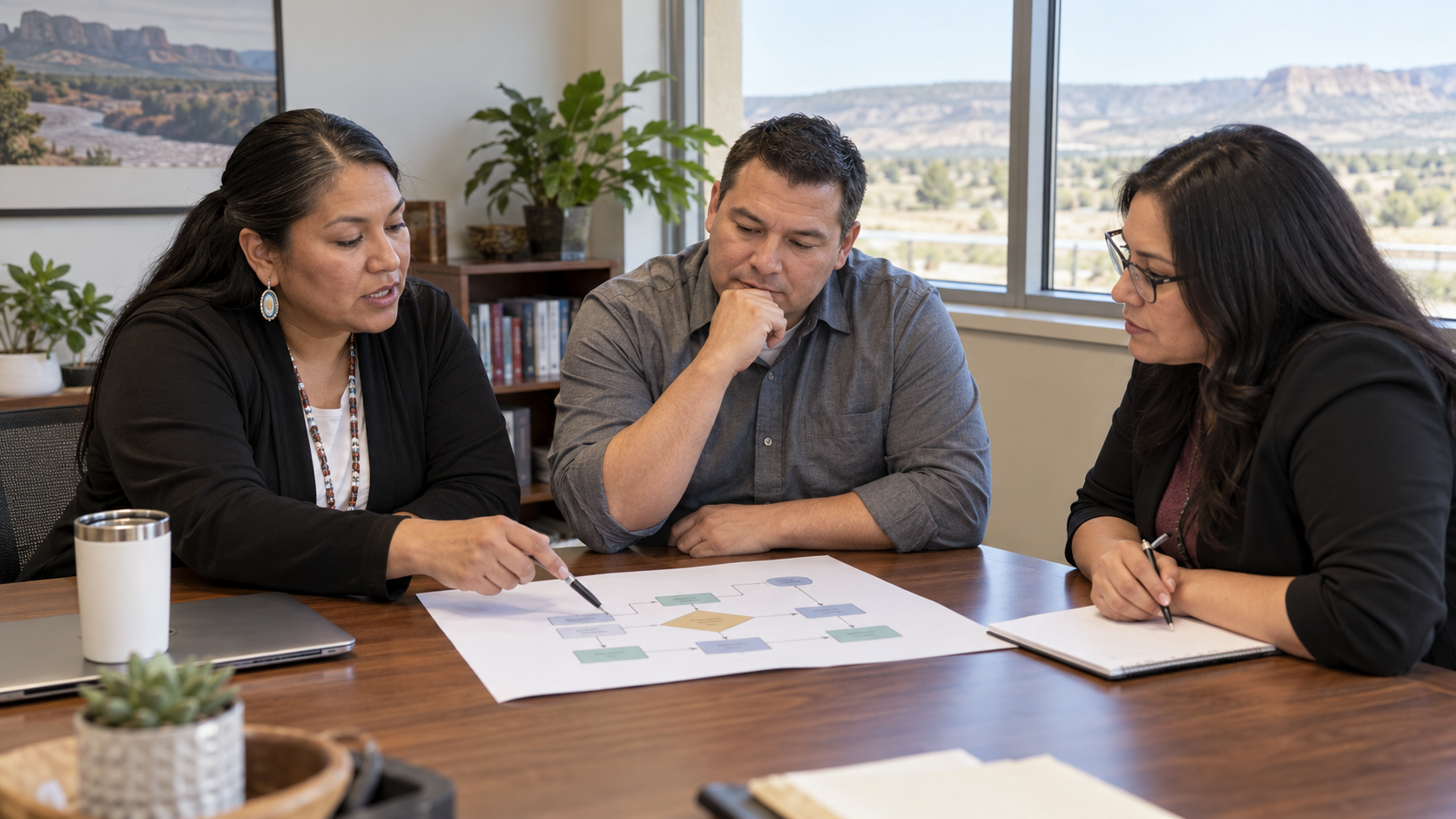
Business-support partners work through a service plan and an Excel budget together in a community office. AI-generated illustration; not a photograph of this project.
A collaboration becomes real when somebody can name who will teach, who will coach and who will follow up. WSMA’s small grant asks two to five partners to reach at least 35 distinct Washington businesses. Shared work matters more than a collection of logos at the bottom of a proposal.
Each selected project receives exactly $10,000. That request may represent no more than 20 percent of the lead’s prior calendar-year or recent twelve-month actual budget, so the relevant budget must reach at least $50,000. Embedded business-support programs use their own budget. Document two years of relevant experience, and make sure grant-funded partners have Evergreen BizLink enrollment or submitted profiles.
The October 16 cutoff is 5 p.m., labeled PST even though daylight time applies that day. Confirm the clock wording before relying on a timed reminder. Upload the required request spreadsheet in Excel, alongside the lead’s current 2026 budget, prior actuals and nonprofit determination letter. The official FAQ clarifies the application instructions’ awkward future-year budget wording.
Before you start
Eligible nonprofits and qualifying business-support organizations serving Washington microbusinesses. Two years of relevant experience must be documented. Grant-funded partners need BizLink enrollment or submitted profiles. Academic institutions cannot receive funding; permitted outside-funded or consultant participation remains possible.
The finer details
Two to five partners and at least 35 distinct Washington businesses. Fixed $10,000 request must pass the 20% prior-actual-budget test. Upload Excel request form, current 2026 budget, prior actuals and nonprofit determination letter.
Washington State businesses
Issuer labels the October cutoff PST although the date falls in Pacific daylight time. Default calendar remains all-day.
Instructions say last full 2026 calendar year; the current FAQ explicitly clarifies current 2026 budget plus 2025 or recent twelve-month actuals.
Guidelines require grant-funded partners to meet eligibility, including the two-year rule; FAQ describes cumulative experience across the collaboration. Confirm how WSMA applies that rule to each partner.
A short first round seeks community power over AI. Grants range from $75,000 to $1 million, and basic AI training is outside the call.
Humanity AI, with application support from Lever for Change · Communities Leading on AI
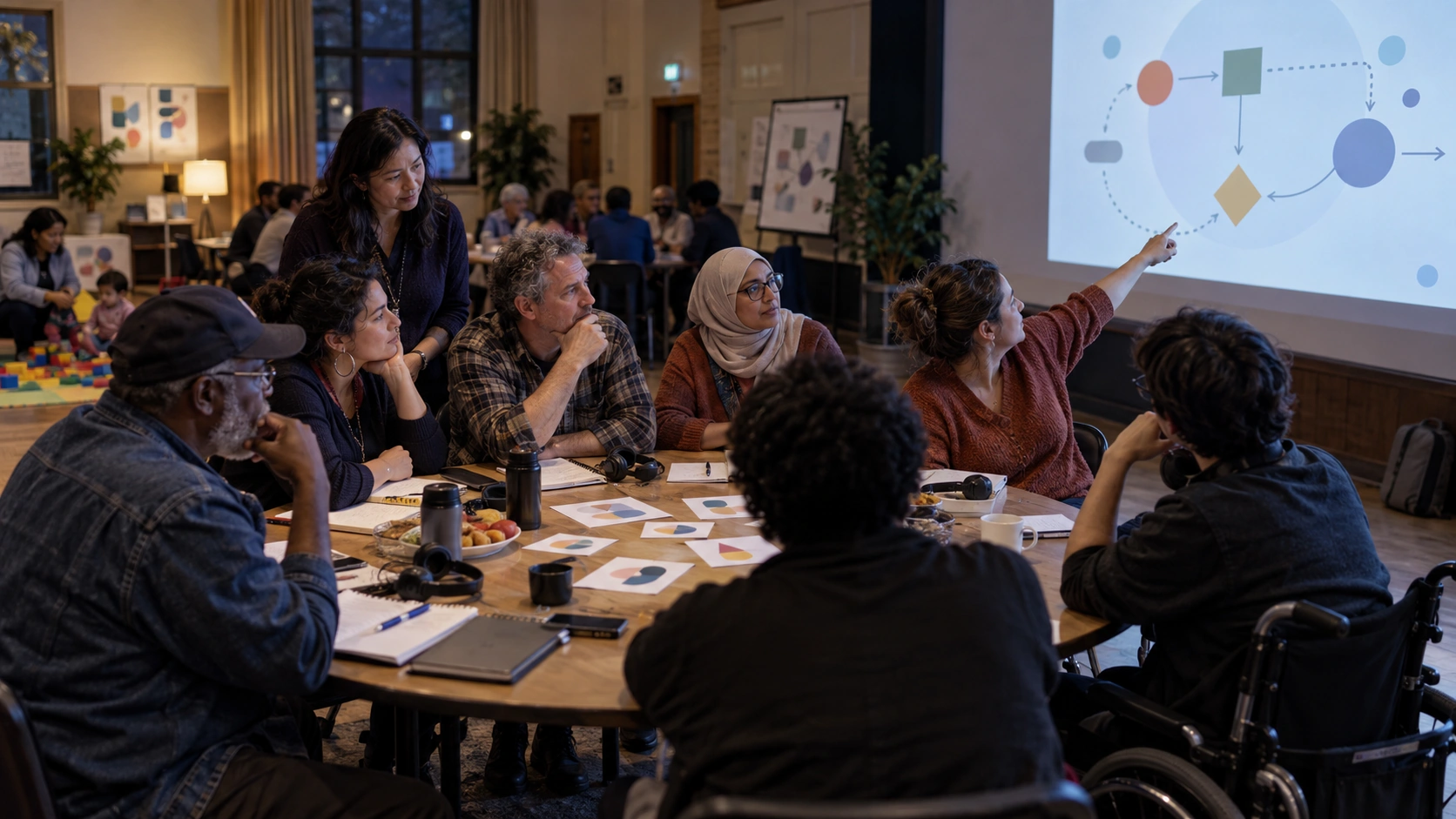
Workers, a student and an artist arrange community decision notes around a shared table with an AI system represented on a screen. AI-generated illustration; not a photograph of this project.
Teaching people how to use an AI tool and giving them a say over its use are different kinds of work. Humanity AI funds the second. Communities must set the goals, shape the approach and drive the proposal, whether they are workers, students, artists or other groups affected by AI.
The shared $10 million fund accepts requests of $75,000 to $1 million for up to three years. Work must connect education, labor and the economy, or humanities and culture with an eligible approach: shaping AI rules, building on community terms, or challenging unwanted deployments. Training-only, tool-adoption and research-only proposals are excluded. Using AI itself is optional.
Applications close October 21 at 4:59 p.m. Pacific. Four main narrative answers total at most 750 words; a conditional question adds 50 words when closed models are central. A US nonprofit lead, eligible fiscal sponsor, Tribal government or public state university must fit the stated route. The short form still needs a serious answer about who holds power.
Before you start
US/territory 501(c)(3) leads and eligible fiscal sponsors, plus qualifying Tribal governments and public state universities. For-profits and foreign entities may collaborate, not lead. 501(c)(4)s cannot join. Direct 2026 Humanity AI grantees cannot apply alone.
The finer details
Community-led work in a listed issue area and approach. Four main narratives: 200/200/150/200 words, plus conditional 50-word closed-model explanation. No budget attachment or partner letters are requested in this first-round template; requested amount/duration are required fields.
OPEN · CATALOG FIRST FEATURE / US and eligible foreign institutions
A transplant question can begin without pilot data
1 min read ·
The Concept Award caps total costs at $200,000 over eighteen months. Its mandatory October 21 letter of intent comes before the November 4 application.
Congressionally Directed Medical Research Programs · FY2026 Reconstructive Transplant Research Program Concept Award, HT942526RTRPCA
A reconstructive-transplant research team studies a hand model and tissue-preservation equipment in a clinical research laboratory. AI-generated illustration; not a photograph of this project.
Restoring a hand or another complex tissue transplant raises questions that a successful operation alone cannot answer. How should rejection be monitored? How can tissue be preserved? Which measures capture meaningful recovery? The Concept Award supports a new, testable idea connected to the program’s reconstructive-transplant focus areas and military health needs.
The maximum is $200,000 in total costs, including indirect costs, over eighteen months. About three awards are anticipated. Nonprofit and commercial organizations, including eligible foreign organizations, can apply with an investigator at postdoctoral level or above. An academic employer is unnecessary. Preliminary data are prohibited, although the rationale and ability to produce interpretable results must be convincing. Submit the mandatory letter of intent through eBRAP by October 21 at 5 p.m. Eastern, then the full application by November 4 at 11:59 p.m. Eastern. No invitation follows the intent stage. Clinical trials are excluded. The companion investigator-initiated award has different evidence requirements; its larger ceiling does not belong to this Concept Award.
Before you start
Eligible domestic or foreign nonprofit, for-profit, public and private organizations; investigator at or above postdoctoral level, affiliated with an eligible organization. No academic-employer requirement. Maximum two Concept applications per investigator; no eligibility cost-share requirement.
The finer details
Mandatory eBRAP letter of intent by 21 October 5 p.m. ET, followed by full submission 4 November. Address a listed reconstructive-transplant focus area and military/public health relevance. Preliminary data and clinical trials are prohibited.
Eligible US and foreign organizations; research must serve the stated military and public relevance
OPEN · CATALOG FIRST FEATURE / US Tribal justice work
Justice support needs more than a toolkit
1 min read ·
Three national support categories carry $400,000, $1.07 million and $400,000. The October 21 first filing must precede the October 28 full application.
Bureau of Justice Assistance, Office of Justice Programs · BJA FY2026 Tribal Justice Training and Technical Assistance Program, O-BJA-2026-172727
Justice-program practitioners review a court implementation plan and training materials around a professional meeting table. AI-generated illustration; not a photograph of this project.
A Tribal justice team may need help translating a strategic plan into a working court or treatment program. This call funds organizations that can provide training and practical assistance across that journey. Applicants choose among strategic planning, justice-system implementation, and support for adult Tribal treatment courts, rather than offering a general training catalog.
The notice anticipates one twelve-month award in each category: $400,000, $1.07 million and $400,000, from up to $1.87 million in total funding. Universities, nonprofits and businesses are listed as eligible. The additional national-scope and on-site Tribal-experience language expressly applies to consortium applicants. Every proposal still needs credible knowledge of the work it promises.
The first filing closes October 21 at 11:59 p.m. Eastern in Grants.gov. The complete JustGrants application follows October 28 at 8:59 p.m. Eastern. Start account checks before the narrative. Consortia need the specified leadership documentation; an unsigned draft may be accepted with a justification. There is no match requirement, but there is no shortcut around relevant experience.
Before you start
Listed universities, nonprofits with or without 501(c)(3) status, businesses, and eligible consortia. Consortium eligibility expressly requires demonstrated national scope and on-site American Indian/Alaska Native expertise. Those additional conditions apply to consortium applicants. The notice lists other eligible entities separately.
The finer details
Mandatory Grants.gov SF-424 by 21 October, then full JustGrants application by 28 October. Consortium leadership agreements are required, with the notice’s justified draft exception. SAM/UEI and portal accounts must be ready.
US Tribal justice assistance; consortium and category requirements apply
Sources checked 14 October 2026. Use the complete official notices to check the first step, eligibility and current terms before deciding to apply or bid.
THE ARKUS SIGNAL / FUNDINGTHE OPPORTUNITIES / 06
OPEN · REPEAT FEATURE / São Paulo and overseas partners
A research visit needs a research partner
1 min read ·
October 26 is the first SPRINT deadline. Initial support pays for São Paulo researchers’ mobility, with later funding dependent on real progress together.
FAPESP · SPRINT 2026: São Paulo Researchers in International Collaboration, Edition 1
São Paulo and visiting research colleagues compare laboratory notebooks beside a scientific instrument before a joint experiment. AI-generated illustration; not a photograph of this project.
A plane ticket can start a partnership; it cannot supply the research question. SPRINT asks a São Paulo team and one foreign institution to build a shared plan around an eligible FAPESP project. The first year funds mobility, while later support depends on what partners learn and accomplish.
Initial funding is up to the equivalent of US$12,500 for twelve months. Successful collaborations can seek another US$12,500 in year two and US$25,000 in year three. Those later amounts are conditional additions, not a guaranteed starting award. Signed foreign cofinancing belongs to the third phase. A foreign partner’s first-year visit to São Paulo is required for progression to phase two.
Edition one closes October 26 without a published hour; edition two follows February 22. The São Paulo lead needs a qualifying grant, although related proposals still under merit review may be submitted conditionally. Both researchers must complete SAGe registration. Choose at least one strategic research theme and explain the benefit to São Paulo. International enthusiasm still needs a specific institutional partner.
Before you start
São Paulo higher-education/research investigators with eligible FAPESP grants and one foreign research institution. Related proposals under merit review may be submitted conditionally; SPRINT is canceled if the related grant remains unapproved at selection. Broad eligible grant categories apply.
The finer details
Both investigators need complete SAGe records and confirmation. One foreign partner institution; proposal in English, up to five pages; a listed strategic theme. SPRINT must start at least six months before the related grant ends. Phase-three cofinancing is not a blanket initial gate.
São Paulo research lead with one foreign institution
No closing hour is printed; calendar dates remain all-day. Later-phase funds are conditional, not guaranteed.
A nonprofit program director and facilities colleague review a concrete equipment-and-program expansion plan in an established workshop. AI-generated illustration; not a photograph of this project.
Equipment, new programs and added staff solve different problems. Murdock asks applicants to choose the expansion they need, then show how to sustain it. Its October 15 opening gives established Northwest organizations a chance to test that fit before building a full application.
Requests begin at $100,000 for projects costing at least $200,000. Eligible organizations need three complete years of operating and financial history, an eligible public or charitable structure, and a qualifying Northwest connection. The guidelines exclude fiscal sponsorships and specified aging services. They also name faith-based organizations in British Columbia while generally excluding non-US entities. Confirm that apparent exception with the Trust.
Complete the eligibility quiz to unlock a short letter of inquiry, due November 11 at 5 p.m. Pacific. Only approved inquiries move to the January 27–March 1 full application window. Hiring dates, purchases, earlier awards and financial readiness affect the expansion. Arts and culture organizations with annual budgets of $200,000 or less must speak with staff before their inquiry.
Before you start
Qualifying US public charities, federally recognized Tribal entities and specified government institutions need three complete years of operations and finances, plus a Northwest base or qualifying regional impact. Fiscal sponsors and several aging-service subsectors are excluded. The guidelines name British Columbia faith-based organizations but also exclude non-US entities; confirm how that conflict applies to this request.
The finer details
Eligibility quiz unlocks the LOI. Minimum request $100,000 and project budget $200,000. Complete the sector and project-type checks, including purchase/hiring timing and prior-grant rules, before committing costs. Arts and culture nonprofits with annual operating budgets of $200,000 or less must complete a conversation with the Trust’s arts staff before submitting an inquiry; an inquiry without that conversation is declined.
Alaska, Idaho, Montana, Oregon, Washington or qualifying regional impact; specific British Columbia faith-based exception
The Trust’s current guidelines name faith-based organizations in British Columbia as eligible while also listing non-US entities as ineligible. Confirm how that conflict applies to a Strategic Project request before relying on the exception.
Seattle’s October 15 opening offers up to $45,000 for digital access. A maximum request needs $11,250 in documented community contributions.
City of Seattle, Seattle IT Digital Equity · Technology Matching Fund 2027 Grants
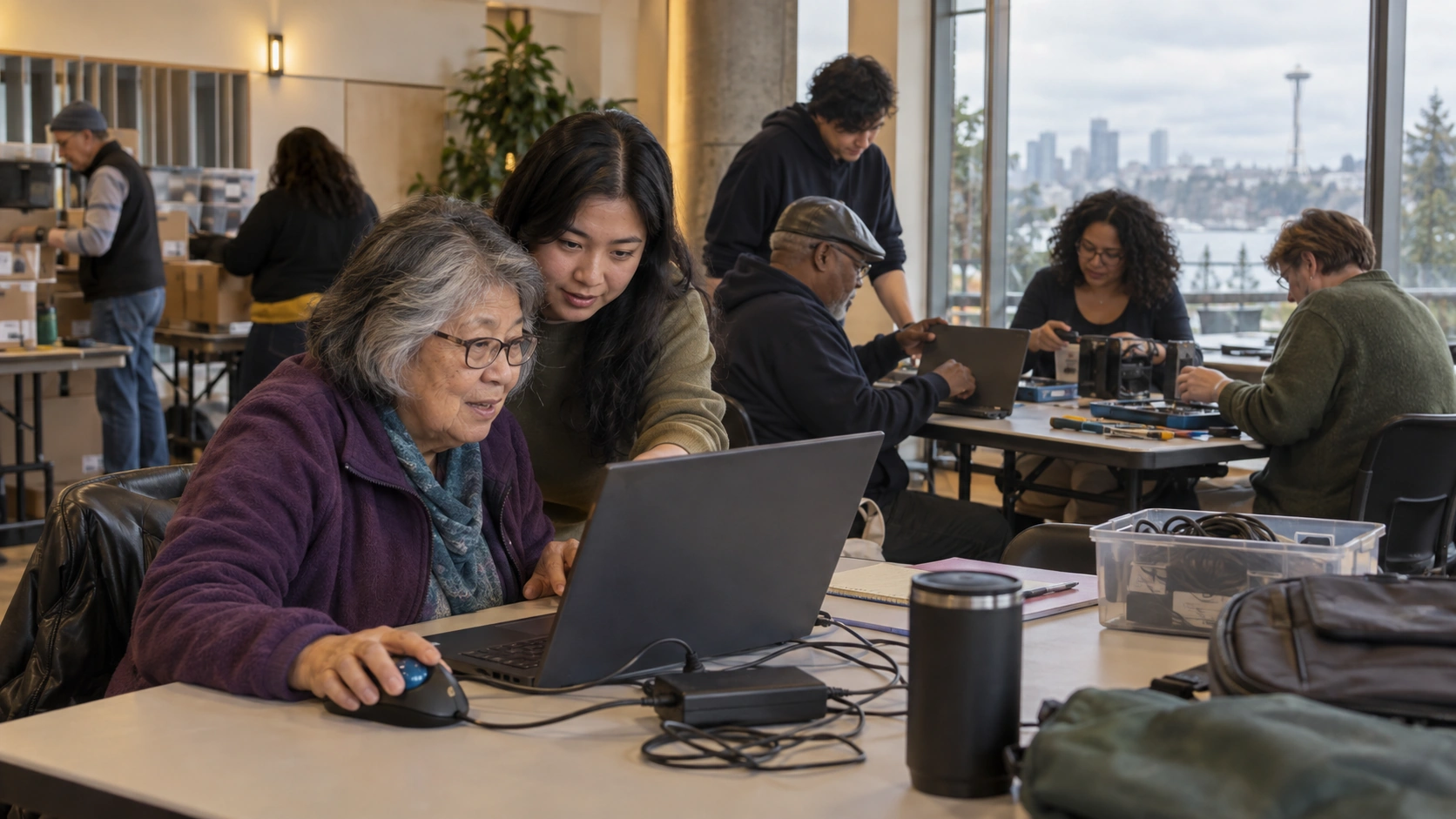
A digital navigator helps an older resident use a laptop at an accessible Seattle neighborhood technology space. AI-generated illustration; not a photograph of this project.
A laptop helps only when someone can connect it, use it and ask for help when it stops cooperating. Seattle’s Technology Matching Fund supports that practical chain: devices, connectivity, digital skills and navigation assistance. The new application window opens October 15 for work carried out within the city’s boundaries.
Awards reach up to $45,000, with approximately $455,000 available across the program. Community contributions must equal at least 25 percent of the request: $11,250 for the maximum award. Match can include documented volunteer time, donated staff services, materials or cash. City resources do not count. Applicants need a Seattle address, and all project activity must happen inside Seattle.
The final deadline is January 15 at 5 p.m., without a printed time zone. Use an all-day reminder until that is clarified. An optional draft review requested by November 17 gives earlier feedback. Eligible community groups may use a nonprofit fiscal sponsor to administer funds; groups with an open digital-equity contract at December’s end cannot receive this award.
Before you start
Eligible Seattle nonprofits, community groups, Tribes/Tribal organizations, PTSAs and nonprofit business associations. Non-charitable groups need an eligible fiscal sponsor for contracting. Seattle address and all activity inside city limits; current digital-equity contracts at 31 December 2026 disqualify a 2027 award.
The finer details
Document confirmed community match of at least 25% of the request. One application per applicant; sponsors may support multiple groups. Set up and verify the Fluxx account. Optional draft-review request is due 17 November.
Applicants and all activities within Seattle city limits
Main page and full guidelines print 5 p.m. without a time zone. Default calendar remains all-day.
The main page’s in-person session details contain an a.m./p.m. conflict; no timed session event is supplied.
OPEN · REPEAT FEATURE / US-based research organizations
The data already exist. The hard work remains
1 min read ·
NSF’s planning grants offer up to $200,000 to prepare scientific datasets for new AI uses. November 4 is the deadline, and this is a return from Issue 02.
U.S. National Science Foundation · Unlocking Dataset Value for AI-Enabled Scientific Discovery (AI Datasets), NSF 26-512
Research colleagues compare an organized scientific dataset and its documentation on large monitors in a shared research workspace. AI-generated illustration; not a photograph of this project.
A scientific dataset can be expensive to collect and surprisingly difficult for the next research team to use. Missing context, inconsistent formats and uncertain permissions all get in the way. NSF’s program supports work that makes existing datasets useful for fresh AI-driven inquiry, including questions beyond their original purpose.
Planning grants offer up to $200,000 to examine early problems, bring research communities together or develop curation approaches. Larger Impact and Flagship awards have separate ceilings of $2 million and $5 million. Building a new dataset from scratch is outside this call. Applicants need to explain the scientific questions, community benefit, security and rules for contribution and reuse.
The November 4 deadline is 5 p.m. in the submitting organization’s local time. Eligible US research and educational nonprofits can lead, alongside other listed applicants; nonprofit status by itself is insufficient. Start the institutional accounts and choose one lead organization to manage the collaboration’s funding. Voluntary committed cost sharing is prohibited. The planning option buys preparation, not an exemption from a serious proposal.
Before you start
Listed US educational institutions, qualifying non-academic nonprofits directly associated with research/education, capable US businesses, state/local governments, Tribal Nations and specified federal entities. No PI or organization proposal limit is stated.
The finer details
Institutional SAM/UEI and Research.gov or Grants.gov setup. Existing scientific data; new collection is outside scope. One lead institution passes partners’ shares through subawards. Planning title prefix required; voluntary committed cost sharing (promised extra resources) is prohibited.
Listed US applicants and scientific research communities
The closing rule is organization-local time; a reader’s institution time zone is needed for a timed calendar. Default calendar remains all-day.
THE ARKUS SIGNAL / IDEAS & EXPERIMENTSBEYOND THE OPPORTUNITIES
Read the small date first
The first action, the right applicant and the meaning of the amount belong in the same plan.
Imagine a small team finishing a thoughtful proposal on a Wednesday afternoon. The budget adds up, the work is sensible, and the final deadline is still weeks away. Then someone finds a sentence about a notice of intent due yesterday. This is a hypothetical scene. The distinction it illustrates deserves a real place in the plan.
An opportunity has more than one clock. There is the date the issuer opens the door, the date an applicant must make a first move, and the date the finished application is due. A question window may be optional. A first-stage submission may determine who can continue. Treating every date as a deadline conceals precisely the difference a reader needs.
Money has similar qualifications. A shared program budget, a maximum request and a typical assignment describe different things. A place on a consultant list offers a way to be found; it does not promise a purchase. The large figure should be prominent, with its meaning just as easy to see.
Useful preparation begins with the decisive condition: the right legal applicant, the right place, the required partner or the first submission. Finding that condition early can prevent wasted work. It can also reveal a sensible role for a team that should join another applicant instead of leading alone.
The practical reading order is simple. Find the first action. Check who can take it. Understand what the amount covers. Then open the official notice and read the whole route. A calendar can remember a date. It cannot supply a missing partner, a registration or permission to enter the next stage. Those still require people.
READ THE OFFICIAL NOTICEFind the first actionKeep the requirement with the date.
READ THE OFFICIAL NOTICECheck who can applyKeep the requirement with the date.
READ THE OFFICIAL NOTICERead the amountKeep the requirement with the date.
Choose what matters most today. Your result suggests a reading order, not whether you qualify.
Circle one choice in each row. Turn your first choice into a source check, your second into a possible role and your third into something useful to bring. There is no score. Use the official notice to test your plan, then bring the remaining questions to the conversation.
A reading prompt, not an eligibility decision. Your choices stay in this browser.
THE ARKUS SIGNALTHE STRIP / THREE ORIGINAL VIEWPOINTS
Between the lines.
Three scenes, each sparked by an opportunity in this week’s editions.
The Clock Has a Question
At the opportunity desk, the small date requests a moment.
THE ARKUS SIGNAL / LAST LOOKTHE PEOPLE BEHIND THE WORK
Two grants. Different first steps.
WATCH THE STORY / 24 SECONDS
THE ARKUS SIGNALFUNDING / 14 OCT 2026
A short guide to NIH virome research and Hartford’s new-partner care grants. Silent, with on-screen captions. Photographs are generated illustrations. The official notices control.
Research, design and practical judgment for the next useful decision.
Chandler LewisFounder and Managing DirectorWalter BenadofPartner - Global Markets and InvestmentsNadia LerougeArkus Deputy Managing DirectorCloud (Yiyun) QiuPartner · Design and Innovation StrategyAarav GhaiResearch Analyst
Arkus Innovation Studios is a commercial innovation studio working with founders, investors and enterprise teams. We help people examine an idea, understand its market and decide what deserves to be built. The work begins with evidence: what is known, what remains uncertain and which next step would make a decision more useful.
Our work includes the Startup Diagnostic, Portfolio Diagnostic and AI Workflow Sprint. Research, design and commercial judgment belong in the same conversation. A technically interesting idea still needs a credible user, a workable route to market and an honest account of its limits. We help make those questions concrete before a team commits to a larger plan.
Arkus, 360 Social Impact Studios and Enough Ventures are separate organizations with different legal structures. Arkus carries commercial advisory and building work; 360 SIS carries nonprofit social-impact work. The distinction matters when an opportunity specifies who can apply or which organization should contract. A shared method does not make their eligibility interchangeable. The Arkus Signal brings useful opportunities, their decisive conditions and official sources into reach. Our team works in English and Portuguese, helping readers turn careful questions into a practical next step.
To explore working together, send Nadia the public call, your idea or capabilities, and the role you have in mind: nadia@arkusinnovationstudios.com. We can then discuss what the work requires and whether Arkus can help.
An Arkus Innovation Studios publicationPeople & possibilities
The Arkus Signal
Grants and funding opportunities worth pursuing
FUNDING EDITION14 OCTOBER 2026ISSUE 05 / PRINT EDITION
Grants & research funding
The viruses that quietly live with us
An October 8 reissue offers small research grants to understand the healthy human virome. The current deadline is November 10, with an unexplained later date in the notice.
A scientist inspects carefully labeled biological specimen tubes and a sequencing workstation in a bright laboratory. AI-generated illustration; not a photograph of this project.
Not every virus in the human body announces itself with an illness. NIH’s Human Virome Program studies the viral communities that normally live in and on us, and the tools needed to understand them. Its newly reissued pilot call invites researchers outside the existing consortium to contribute distinct work.
Inside: twelve funding stories, with checked official notices, useful repeat coverage and clear first steps. New features and newly issued calls are identified separately.
Read the opening condition
Two grants. Two different first steps.
Choose a call to see its first step.
NIH Common Fund, administered by NIDCR
Map the viruses that live within.
NIH funds small studies that could open a path toward mapping the human virome. The award covers direct costs; the proposal date uses the applicant organization’s local time.
Hartford seeks new partners with national or multi-site aging-care projects. Read the prior-grant rule and complete portal registration by the safe October 21 early gate before the October 27 inquiry.
Generated editorial scenes. NIH’s pilot supports research; Hartford’s program supports aging care. Each has its own eligibility and first step. Read the full notices.Read the story ↗
THE ARKUS SIGNAL / FUNDINGTHE OPPORTUNITIES / 02
OPEN · REISSUED 8 OCTOBER / US applicants; international work follows the notice
The viruses that quietly live with us
1 min read ·
An October 8 reissue offers small research grants to understand the healthy human virome. The current deadline is November 10, with an unexplained later date in the notice.
NIH Common Fund, administered by NIDCR · Pilot Projects to Enhance the Human Virome Program (R03 Clinical Trials Not Allowed), RFA-RM-27-024
A scientist inspects carefully labeled biological specimen tubes and a sequencing workstation in a bright laboratory. AI-generated illustration; not a photograph of this project.
Not every virus in the human body announces itself with an illness. NIH’s Human Virome Program studies the viral communities that normally live in and on us, and the tools needed to understand them. Its newly reissued pilot call invites researchers outside the existing consortium to contribute distinct work.
The award allows up to $100,000 in direct costs per year for a maximum of two years, with both years’ funds paid in the first year. Projects can improve assays, methods or models, or extend suitable sampling. Clinical trials are excluded. A credible pilot needs a clear connection to the program, rather than a general interest in viruses.
The current receipt date is November 10 at 5 p.m. in the applicant organization’s local time. Start institutional and investigator registrations now. The notice also prints an October 2027 date after its stated expiration; treat that future cycle as unconfirmed. Domestic nonprofits and other listed US entities can apply; foreign applicants and funded foreign subawards cannot.
Before you start
Listed US institutions, nonprofits, businesses and public entities may apply. Foreign organizations and non-US components cannot apply; foreign components are allowed, but foreign subawards/subcontracts are prohibited. No cost share.
The finer details
Complete SAM/UEI, Grants.gov and eRA Commons registrations, including signing-official and investigator accounts. Work must extend the Human Virome Program; clinical trials are excluded.
US applicants; permitted international collaboration must follow the notice
The due-date table lists 22 October 2027 although the stated expiration is 11 November 2026. No later cycle is promised.
Grants.gov metadata says 13 expected awards; the full notice says approximately six. The full notice controls.
Organization-local time needs the reader’s organization time zone; the default reminder remains all-day.
OPEN · OLDER DISCOVERY / US national or multisite care
A new partner needs a wider map
1 min read ·
Hartford offers up to $300,000 over two years for care improvements that can travel. Register by October 21, before the October 27 letter of intent.
The John A. Hartford Foundation · JAHF New Partners Program: National Initiatives Advancing Improvements in Care for Older Adults
Older adults and a family caregiver review a care-planning sheet with a clinician at a welcoming community health meeting. AI-generated illustration; not a photograph of this project.
A useful improvement in older adults’ care should be able to leave the building where it began. Hartford’s New Partners Program seeks national or multisite work in age-friendly health systems, family caregiving, or serious illness and end-of-life care. A single busy service site will not meet the brief.
Up to ten grants offer as much as $300,000 over two years, including indirect costs. The October 7 FAQ defines eligible new partners as organizations, or academic departments, without a board-authorized Hartford grant in the past thirty years. Never-funded applicants receive priority. Eligible fiscal sponsors can also provide the legal and financial home for a project.
Register in the grants portal by October 21 at noon Eastern; the letter of intent, a short opening proposal, follows October 27 at noon. Financial documents accompany that first proposal. Plan to explain how older adults and caregivers shape the work, how it can spread, and what sustains it. Routine services and general operating support are excluded.
Before you start
US public charities, qualifying colleges/universities, hospitals and health care organizations; eligible 501(c)(3) fiscal sponsors are allowed. No board-authorized Hartford grant in the past 30 years; never-funded applicants receive priority. US older adults or caregivers must benefit.
The finer details
Register by 21 October noon ET, then submit the LOI with financial documents by 27 October noon ET. National or multisite scope is required. One LOI per organization, with the FAQ’s distinct academic-division exception.
US-based organizations and work benefiting older adults or caregivers in the US
The CFP and FAQ process overview give 21 October as the registration deadline; FAQ answer 25 calls that date highly recommended. Keep it as the safe early gate.
Exact original issue date was not located. A Hartford-supported research-network announcement proves the call existed by 30 September.
OPEN · OLDER DISCOVERY / US states, DC and territories
The people behind the small businesses
1 min read ·
Visa’s flexible $100,000–$250,000 grants support organizations serving operating businesses. The applicant’s annual budget must fall between $1 million and $10 million.
Visa Foundation, administered by Rockefeller Philanthropy Advisors · Visa Foundation U.S. Small Business Growth and Innovation Program
A business adviser and a small shop owner study a cash-flow notebook beside a laptop in a modest working storefront. AI-generated illustration; not a photograph of this project.
The adviser helping a shop owner untangle a cash-flow problem also needs time, tools and a salary. Visa’s program funds organizations supporting small or microbusinesses already trading.
Anticipated twelve-month grants of $100,000–$250,000 share a $2 million pool and may cover staff and administration, starting January 2027. Eligible US public charities need annual operating budgets of $1 million–$10 million and two years of audited accounts or tax returns. Qualifying fiscally sponsored projects must meet those rules, too.
Apply October 21 by noon Pacific after organization verification. Upload the current board-approved budget and historical financials. One application is permitted per tax identifier; submissions are not confidential. Serving fewer than 200 businesses annually affects competitiveness, not eligibility. The linked full form was unavailable for review; read it before committing. Additional conditions may apply.
Before you start
US-based 501(c)(3) public charities directly serving operating small or microbusinesses; qualifying fiscally sponsored projects and separately incorporated local chapters are allowed. Annual operating budget $1 million–$10 million; two years of audited financials or IRS Form 990s.
The finer details
Create an account and register the organization for verification. Upload two years of financials and the current board-approved 2026/2027 operating budget. One application per EIN; applications are not treated as confidential.
50 US states, District of Columbia and US territories
The linked application-question PDF and portal contents were not available for review. Read the full form before committing to an application; additional conditions may apply.
ROLLING · OLDER DISCOVERY / Global research; confirm applicant type
Research help that arrives as credits
1 min read ·
Up to $50,000 per project can pay for Claude usage, not laboratory salaries. The rolling science program has a qualification question worth settling first.
Anthropic · Anthropic AI for Science Program
A researcher reviews scientific computing results on a workstation while a notebook records a carefully framed research question. AI-generated illustration; not a photograph of this project.
Compute bills can interrupt a promising research question. Anthropic offers selected projects up to $50,000 per project in Claude usage credits, not cash for salaries, equipment or experiments. Approval is discretionary.
The announcement welcomes any researcher, but the live form describes qualified nonprofit and academic researchers unless otherwise specified. Applicants outside those groups should confirm their route. Credentials, likely research impact and whether AI meaningfully speeds the work guide selection. The form states monthly review, without promising a decision date.
Apply through AI for Science. The separate team-plan offer requires a principal investigator or equivalent at an academic or nonprofit research institution; its qualifications and benefits are different. Describe the research and expected model use, including usage restrictions. The credit call is rolling, with no published deadline. Choose your own reminder date.
Before you start
The current credit announcement says any researcher may apply; the live form describes qualified nonprofit and academic researchers unless otherwise specified. Applicants outside those categories should confirm the route. The separate team plan requires a PI or equivalent at an academic or nonprofit research institution.
The finer details
Use the AI for Science form, not the separate team-plan verification route. Selection depends on credentials, research impact and meaningful AI acceleration. Monthly review is stated; model and usage rules still apply.
Science researchers; no country restriction stated in the inspected announcement or form
The August announcement welcomes any researcher, while the live form describes nonprofit and academic researchers. Applicants outside those groups should confirm their route before relying on the offer.
No deadline or guaranteed decision time is published. Choose the reminder date; model and usage restrictions apply.
Fifteen fixed $10,000 awards close October 16. Partners, financial records and a plan for 35 Washington businesses need to be ready together.
Washington State Microenterprise Association · WSMA 2026–27 Statewide Grant Opportunity: Collaborative Projects
Business-support partners work through a service plan and an Excel budget together in a community office. AI-generated illustration; not a photograph of this project.
A collaboration becomes real when somebody can name who will teach, who will coach and who will follow up. WSMA’s small grant asks two to five partners to reach at least 35 distinct Washington businesses. Shared work matters more than a collection of logos at the bottom of a proposal.
Each selected project receives exactly $10,000. That request may represent no more than 20 percent of the lead’s prior calendar-year or recent twelve-month actual budget, so the relevant budget must reach at least $50,000. Embedded business-support programs use their own budget. Document two years of relevant experience, and make sure grant-funded partners have Evergreen BizLink enrollment or submitted profiles.
The October 16 cutoff is 5 p.m., labeled PST even though daylight time applies that day. Confirm the clock wording before relying on a timed reminder. Upload the required request spreadsheet in Excel, alongside the lead’s current 2026 budget, prior actuals and nonprofit determination letter. The official FAQ clarifies the application instructions’ awkward future-year budget wording.
Before you start
Eligible nonprofits and qualifying business-support organizations serving Washington microbusinesses. Two years of relevant experience must be documented. Grant-funded partners need BizLink enrollment or submitted profiles. Academic institutions cannot receive funding; permitted outside-funded or consultant participation remains possible.
The finer details
Two to five partners and at least 35 distinct Washington businesses. Fixed $10,000 request must pass the 20% prior-actual-budget test. Upload Excel request form, current 2026 budget, prior actuals and nonprofit determination letter.
Washington State businesses
Issuer labels the October cutoff PST although the date falls in Pacific daylight time. Default calendar remains all-day.
Instructions say last full 2026 calendar year; the current FAQ explicitly clarifies current 2026 budget plus 2025 or recent twelve-month actuals.
Guidelines require grant-funded partners to meet eligibility, including the two-year rule; FAQ describes cumulative experience across the collaboration. Confirm how WSMA applies that rule to each partner.
A short first round seeks community power over AI. Grants range from $75,000 to $1 million, and basic AI training is outside the call.
Humanity AI, with application support from Lever for Change · Communities Leading on AI
Workers, a student and an artist arrange community decision notes around a shared table with an AI system represented on a screen. AI-generated illustration; not a photograph of this project.
Teaching people how to use an AI tool and giving them a say over its use are different kinds of work. Humanity AI funds the second. Communities must set the goals, shape the approach and drive the proposal, whether they are workers, students, artists or other groups affected by AI.
The shared $10 million fund accepts requests of $75,000 to $1 million for up to three years. Work must connect education, labor and the economy, or humanities and culture with an eligible approach: shaping AI rules, building on community terms, or challenging unwanted deployments. Training-only, tool-adoption and research-only proposals are excluded. Using AI itself is optional.
Applications close October 21 at 4:59 p.m. Pacific. Four main narrative answers total at most 750 words; a conditional question adds 50 words when closed models are central. A US nonprofit lead, eligible fiscal sponsor, Tribal government or public state university must fit the stated route. The short form still needs a serious answer about who holds power.
Before you start
US/territory 501(c)(3) leads and eligible fiscal sponsors, plus qualifying Tribal governments and public state universities. For-profits and foreign entities may collaborate, not lead. 501(c)(4)s cannot join. Direct 2026 Humanity AI grantees cannot apply alone.
The finer details
Community-led work in a listed issue area and approach. Four main narratives: 200/200/150/200 words, plus conditional 50-word closed-model explanation. No budget attachment or partner letters are requested in this first-round template; requested amount/duration are required fields.
OPEN · CATALOG FIRST FEATURE / US and eligible foreign institutions
A transplant question can begin without pilot data
1 min read ·
The Concept Award caps total costs at $200,000 over eighteen months. Its mandatory October 21 letter of intent comes before the November 4 application.
Congressionally Directed Medical Research Programs · FY2026 Reconstructive Transplant Research Program Concept Award, HT942526RTRPCA
A reconstructive-transplant research team studies a hand model and tissue-preservation equipment in a clinical research laboratory. AI-generated illustration; not a photograph of this project.
Restoring a hand leaves questions about rejection, preservation and recovery. The Concept Award backs a testable reconstructive-transplant idea linked to military and veteran health needs.
Up to $200,000 covers total costs, including indirect costs, for eighteen months. About three awards are anticipated. Eligible US and foreign organizations may apply with an affiliated investigator at postdoctoral level or above; an academic employer is unnecessary. Preliminary data and clinical trials are prohibited. The companion award’s $1 million ceiling belongs to a different mechanism. File the mandatory eBRAP letter of intent by October 21, 5 p.m. Eastern. Submit the full application by November 4, 11:59 p.m. Eastern, and finish verification by November 9, 5 p.m. Eastern. No invitation follows intent. Each investigator may submit at most two Concept applications; the stages require separate preparation.
Before you start
Eligible domestic or foreign nonprofit, for-profit, public and private organizations; investigator at or above postdoctoral level, affiliated with an eligible organization. No academic-employer requirement. Maximum two Concept applications per investigator; no eligibility cost-share requirement.
The finer details
Mandatory eBRAP letter of intent by 21 October 5 p.m. ET, followed by full submission 4 November. Address a listed reconstructive-transplant focus area and military/public health relevance. Preliminary data and clinical trials are prohibited.
Eligible US and foreign organizations; research must serve the stated military and public relevance
OPEN · CATALOG FIRST FEATURE / US Tribal justice work
Justice support needs more than a toolkit
1 min read ·
Three national support categories carry $400,000, $1.07 million and $400,000. The October 21 first filing must precede the October 28 full application.
Bureau of Justice Assistance, Office of Justice Programs · BJA FY2026 Tribal Justice Training and Technical Assistance Program, O-BJA-2026-172727
Justice-program practitioners review a court implementation plan and training materials around a professional meeting table. AI-generated illustration; not a photograph of this project.
A Tribal justice team may need help turning its plan into a working court or treatment program. This call funds practical assistance in strategic planning, justice-system implementation and adult Tribal treatment courts.
Three anticipated twelve-month awards are $400,000, $1.07 million and $400,000, one per category, beginning January 1, 2027, from up to $1.87 million shared. Listed universities, nonprofits and businesses may apply. Consortia specifically must demonstrate national scope and on-site Tribal experience. No match is required.
File the mandatory Grants.gov first submission by October 21, 11:59 p.m. Eastern, then the complete JustGrants application by October 28, 8:59 p.m. Eastern. Check SAM/UEI and portal accounts early. Consortia need leadership agreements; a justified unsigned draft may be accepted. Choose the category that fits the work you can deliver, and document the relevant experience.
Before you start
Listed universities, nonprofits with or without 501(c)(3) status, businesses, and eligible consortia. Consortium eligibility expressly requires demonstrated national scope and on-site American Indian/Alaska Native expertise. Those additional conditions apply to consortium applicants. The notice lists other eligible entities separately.
The finer details
Mandatory Grants.gov SF-424 by 21 October, then full JustGrants application by 28 October. Consortium leadership agreements are required, with the notice’s justified draft exception. SAM/UEI and portal accounts must be ready.
US Tribal justice assistance; consortium and category requirements apply
Sources checked 14 October 2026. Use the complete official notices to check the first step, eligibility and current terms before deciding to apply or bid.
THE ARKUS SIGNAL / FUNDINGTHE OPPORTUNITIES / 06
OPEN · REPEAT FEATURE / São Paulo and overseas partners
A research visit needs a research partner
1 min read ·
October 26 is the first SPRINT deadline. Initial support pays for São Paulo researchers’ mobility, with later funding dependent on real progress together.
FAPESP · SPRINT 2026: São Paulo Researchers in International Collaboration, Edition 1
São Paulo and visiting research colleagues compare laboratory notebooks beside a scientific instrument before a joint experiment. AI-generated illustration; not a photograph of this project.
Travel starts the collaboration; the research question gives it a purpose. SPRINT connects an eligible São Paulo project with one foreign research institution.
First-year mobility support reaches the equivalent of US$12,500. Later approved phases may add US$12,500 and US$25,000, with formal foreign cofinancing required only for phase three. A foreign partner must visit São Paulo in year one to reach phase two. Those additions are conditional.
Edition one closes October 26; no hour is published, so use an all-day reminder. Both researchers need complete SAGe records, an English proposal within five pages and a listed strategic theme. Start at least six months before the related grant ends. A proposal under review may enter conditionally, but SPRINT is canceled if that grant remains unapproved at selection. Edition two closes February 22, 2027.
Before you start
São Paulo higher-education/research investigators with eligible FAPESP grants and one foreign research institution. Related proposals under merit review may be submitted conditionally; SPRINT is canceled if the related grant remains unapproved at selection. Broad eligible grant categories apply.
The finer details
Both investigators need complete SAGe records and confirmation. One foreign partner institution; proposal in English, up to five pages; a listed strategic theme. SPRINT must start at least six months before the related grant ends. Phase-three cofinancing is not a blanket initial gate.
São Paulo research lead with one foreign institution
No closing hour is printed; calendar dates remain all-day. Later-phase funds are conditional, not guaranteed.
A nonprofit program director and facilities colleague review a concrete equipment-and-program expansion plan in an established workshop. AI-generated illustration; not a photograph of this project.
Equipment, a program and another staff member solve different problems. Murdock asks established Northwest organizations to choose their expansion and show how it will last.
Requests start at $100,000 for projects costing at least $200,000. These are minimums. Eligible US applicants need three complete years of operating and financial history; fiscal sponsors and specified aging services are excluded. Guidelines name British Columbia faith-based groups while excluding non-US entities. Confirm that conflict with the Trust.
Opening October 15, the eligibility quiz unlocks an inquiry due November 11, 5 p.m. Pacific. Approved inquiries alone reach the January 27–March 1, 2027 application window, closing at 5 p.m. Pacific. Arts and culture groups with annual operating budgets of $200,000 or less must speak with arts staff before their inquiry. Check project-specific purchase, hiring and financing rules.
Before you start
Qualifying US public charities, federally recognized Tribal entities and specified government institutions need three complete years of operations and finances, plus a Northwest base or qualifying regional impact. Fiscal sponsors and several aging-service subsectors are excluded. The guidelines name British Columbia faith-based organizations but also exclude non-US entities; confirm how that conflict applies to this request.
The finer details
Eligibility quiz unlocks the LOI. Minimum request $100,000 and project budget $200,000. Complete the sector and project-type checks, including purchase/hiring timing and prior-grant rules, before committing costs. Arts and culture nonprofits with annual operating budgets of $200,000 or less must complete a conversation with the Trust’s arts staff before submitting an inquiry; an inquiry without that conversation is declined.
Alaska, Idaho, Montana, Oregon, Washington or qualifying regional impact; specific British Columbia faith-based exception
The Trust’s current guidelines name faith-based organizations in British Columbia as eligible while also listing non-US entities as ineligible. Confirm how that conflict applies to a Strategic Project request before relying on the exception.
Seattle’s October 15 opening offers up to $45,000 for digital access. A maximum request needs $11,250 in documented community contributions.
City of Seattle, Seattle IT Digital Equity · Technology Matching Fund 2027 Grants
A digital navigator helps an older resident use a laptop at an accessible Seattle neighborhood technology space. AI-generated illustration; not a photograph of this project.
A laptop helps when someone can connect it and ask for help. Seattle’s fund backs that practical chain: devices, connections, skills and navigation.
Awards reach $45,000 from about $455,000 shared. Match must equal at least 25 percent of the request: $11,250 at the maximum. Document confirmed donated time, services, materials or money; City resources do not count. Applicants need a Seattle address, with all work inside city limits.
The window opens October 15 and closes January 15, 2027, 5 p.m.; the time zone is unstated. Use an all-day reminder. Request optional draft feedback by November 17; in-person session times also conflict. Eligible community groups may use a fiscal sponsor. It can sponsor several groups. One application per applicant is allowed. An existing digital-equity contract at December 31, 2026 disqualifies a 2027 award. Verify the Fluxx account and match before applying.
Before you start
Eligible Seattle nonprofits, community groups, Tribes/Tribal organizations, PTSAs and nonprofit business associations. Non-charitable groups need an eligible fiscal sponsor for contracting. Seattle address and all activity inside city limits; current digital-equity contracts at 31 December 2026 disqualify a 2027 award.
The finer details
Document confirmed community match of at least 25% of the request. One application per applicant; sponsors may support multiple groups. Set up and verify the Fluxx account. Optional draft-review request is due 17 November.
Applicants and all activities within Seattle city limits
Main page and full guidelines print 5 p.m. without a time zone. Default calendar remains all-day.
The main page’s in-person session details contain an a.m./p.m. conflict; no timed session event is supplied.
OPEN · REPEAT FEATURE / US-based research organizations
The data already exist. The hard work remains
1 min read ·
NSF’s planning grants offer up to $200,000 to prepare scientific datasets for new AI uses. November 4 is the deadline, and this is a return from Issue 02.
U.S. National Science Foundation · Unlocking Dataset Value for AI-Enabled Scientific Discovery (AI Datasets), NSF 26-512
Research colleagues compare an organized scientific dataset and its documentation on large monitors in a shared research workspace. AI-generated illustration; not a photograph of this project.
A dataset can cost years of work and still puzzle the next researcher. NSF supports preparing existing scientific data for useful AI research, including questions beyond their original purpose.
Planning grants offer up to $200,000; separate Impact and Flagship tiers reach $2 million and $5 million. These are ceilings, subject to available funds. New data collection is outside scope. Eligible US educational and research organizations can lead, alongside other listed applicants; nonprofit status alone is insufficient.
Apply November 4 by 5 p.m. in the submitting organization’s local time. Choose that time zone before a timed reminder. Prepare SAM/UEI and portal accounts, name one lead to channel subawards, and use the Planning title prefix. Explain curation, reuse, security and community benefit. Do not promise extra resources as voluntary cost sharing; planning still requires a thoughtful proposal.
Before you start
Listed US educational institutions, qualifying non-academic nonprofits directly associated with research/education, capable US businesses, state/local governments, Tribal Nations and specified federal entities. No PI or organization proposal limit is stated.
The finer details
Institutional SAM/UEI and Research.gov or Grants.gov setup. Existing scientific data; new collection is outside scope. One lead institution passes partners’ shares through subawards. Planning title prefix required; voluntary committed cost sharing (promised extra resources) is prohibited.
Listed US applicants and scientific research communities
The closing rule is organization-local time; a reader’s institution time zone is needed for a timed calendar. Default calendar remains all-day.
THE ARKUS SIGNAL / IDEAS & EXPERIMENTSBEYOND THE OPPORTUNITIES
Read the small date first
The first action, the right applicant and the meaning of the amount belong in the same plan.
Imagine a small team finishing a thoughtful proposal on a Wednesday afternoon. The budget adds up, the work is sensible, and the final deadline is still weeks away. Then someone finds a sentence about a notice of intent due yesterday. This is a hypothetical scene. The distinction it illustrates deserves a real place in the plan.
An opportunity has more than one clock. There is the date the issuer opens the door, the date an applicant must make a first move, and the date the finished application is due. A question window may be optional. A first-stage submission may determine who can continue. Treating every date as a deadline conceals precisely the difference a reader needs.
Money has similar qualifications. A shared program budget, a maximum request and a typical assignment describe different things. A place on a consultant list offers a way to be found; it does not promise a purchase. The large figure should be prominent, with its meaning just as easy to see.
Useful preparation begins with the decisive condition: the right legal applicant, the right place, the required partner or the first submission. Finding that condition early can prevent wasted work. It can also reveal a sensible role for a team that should join another applicant instead of leading alone.
The practical reading order is simple. Find the first action. Check who can take it. Understand what the amount covers. Then open the official notice and read the whole route. A calendar can remember a date. It cannot supply a missing partner, a registration or permission to enter the next stage. Those still require people.
READ THE OFFICIAL NOTICEFind the first actionKeep the requirement with the date.
READ THE OFFICIAL NOTICECheck who can applyKeep the requirement with the date.
READ THE OFFICIAL NOTICERead the amountKeep the requirement with the date.
Choose what matters most today. Your result suggests a reading order, not whether you qualify.
Circle one answer for each question. Turn your first choice into a source check, your second into a possible role and your third into something useful to bring. There is no score. Use the official notice to test your plan, then bring the remaining questions to the conversation.
A reading prompt, not an eligibility decision.
THE ARKUS SIGNALTHE STRIP / THREE ORIGINAL VIEWPOINTS
Between the lines.
Three scenes, each sparked by an opportunity in this week’s editions.
The Clock Has a Question
At the opportunity desk, the small date requests a moment.
THE ARKUS SIGNAL / LAST LOOKTHE PEOPLE BEHIND THE WORK
Two grants. Different first steps.
WATCH THE STORY / 24 SECONDS
THE ARKUS SIGNALFUNDING / 14 OCT 2026
A short guide to NIH virome research and Hartford’s new-partner care grants. Silent, with on-screen captions. Photographs are generated illustrations. The official notices control.
Research, design and practical judgment for the next useful decision.
Chandler LewisFounder and Managing DirectorWalter BenadofPartner - Global Markets and InvestmentsNadia LerougeArkus Deputy Managing DirectorCloud (Yiyun) QiuPartner · Design and Innovation StrategyAarav GhaiResearch Analyst
Arkus Innovation Studios is a commercial innovation studio working with founders, investors and enterprise teams. We help people examine an idea, understand its market and decide what deserves to be built. The work begins with evidence: what is known, what remains uncertain and which next step would make a decision more useful.
Our work includes the Startup Diagnostic, Portfolio Diagnostic and AI Workflow Sprint. Research, design and commercial judgment belong in the same conversation. A technically interesting idea still needs a credible user, a workable route to market and an honest account of its limits. We help make those questions concrete before a team commits to a larger plan.
Arkus, 360 Social Impact Studios and Enough Ventures are separate organizations with different legal structures. Arkus carries commercial advisory and building work; 360 SIS carries nonprofit social-impact work. The distinction matters when an opportunity specifies who can apply or which organization should contract. A shared method does not make their eligibility interchangeable. The Arkus Signal brings useful opportunities, their decisive conditions and official sources into reach. Our team works in English and Portuguese, helping readers turn careful questions into a practical next step.
To explore working together, send Nadia the public call, your idea or capabilities, and the role you have in mind: nadia@arkusinnovationstudios.com. We can then discuss what the work requires and whether Arkus can help.